

Park · Brooklyn · ⭐ 9.3/10 · 4776 reviews · updated: 2026-08-04 20:05:52
Address: Fillmore Ave, Brooklyn, NY 11229, United States
Marine Park — Brooklyn’s largest park, and its last great salt marsh
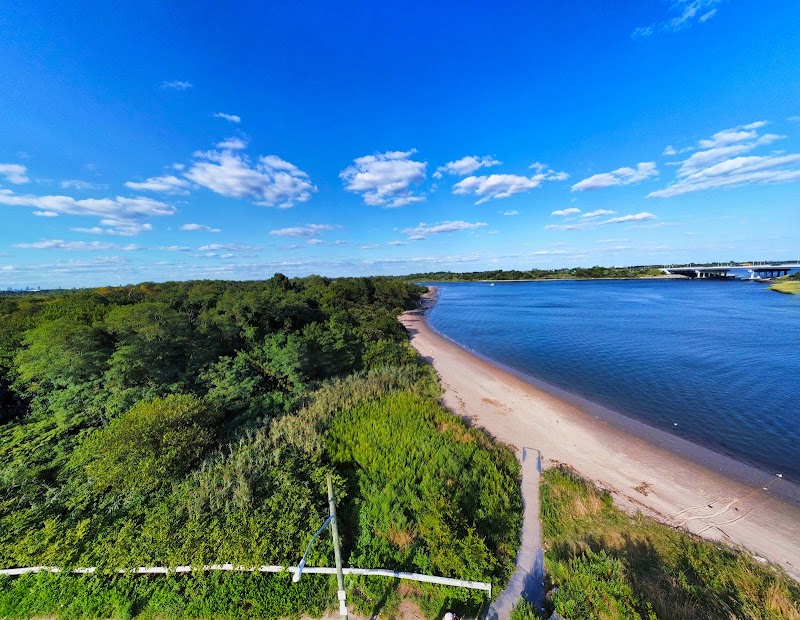
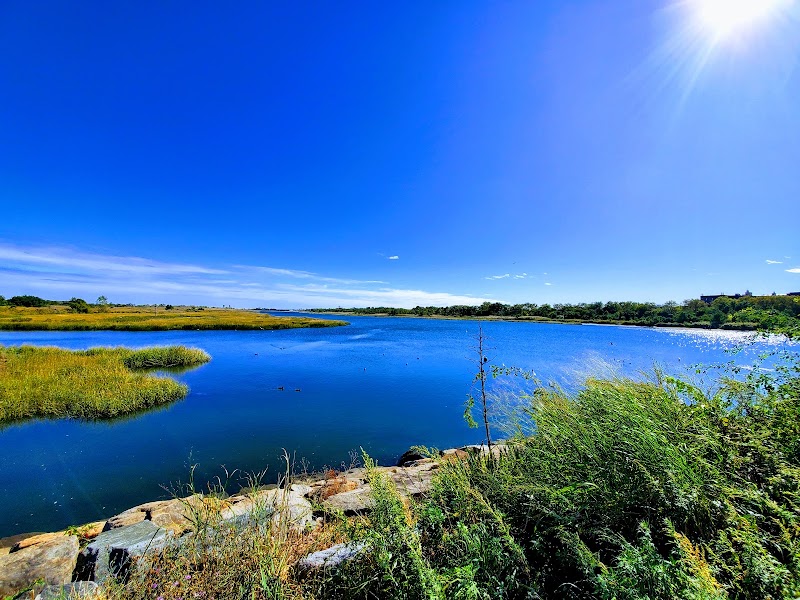
Almost eight hundred acres on the edge of Jamaica Bay, and most visitors never see the half that matters most. Marine Park is Brooklyn’s biggest park by a wide margin, and it splits neatly in two: a hard-working recreational half of ballfields, courts and a municipal golf course, and a wild half where Gerritsen Creek runs tidal through cordgrass, egrets stalk the shallows and osprey hunt from a nesting platform above the water. This is one of the few places in New York City where you can stand in silence, smell salt and low-tide mud, and watch fiddler crabs work a bank — twenty minutes from a subway, with the towers of Manhattan nowhere in sight.
Highlights
- The Salt Marsh Nature Center — opened in 2000 and staffed by the Urban Park Rangers, it is the gateway to the preserve, running free public programs, school sessions and guided walks year-round.
- The Salt Marsh Nature Trail — a loop of boardwalk and packed path behind the Nature Center with viewing platforms, a creek bridge, an osprey nesting platform and stands of cottonwood; part of roughly fifteen miles of walking trails inside the park.
- Gerritsen Creek — a genuine tidal creek, the freshwater-and-saltwater engine of the whole system, where the water level and the wildlife change completely between high tide and low.
- The preserve itself — around 530 acres of salt marsh, grassland and maritime forest that draw more than 270 bird species, some 50 kinds of butterfly and about 100 species of fish.
- Marine Park Golf Course — a 210-acre municipal course designed by Robert Trent Jones and opened in 1963, with a driving range, the largest public course in the borough.
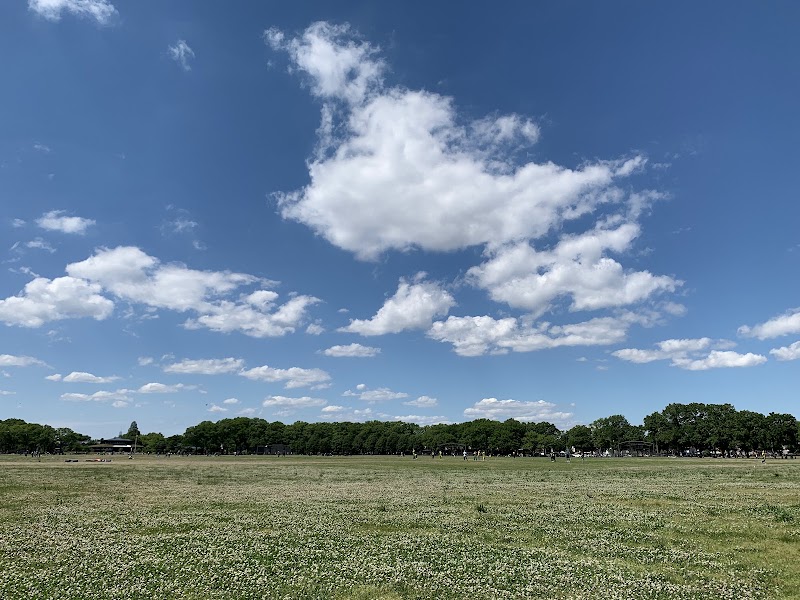
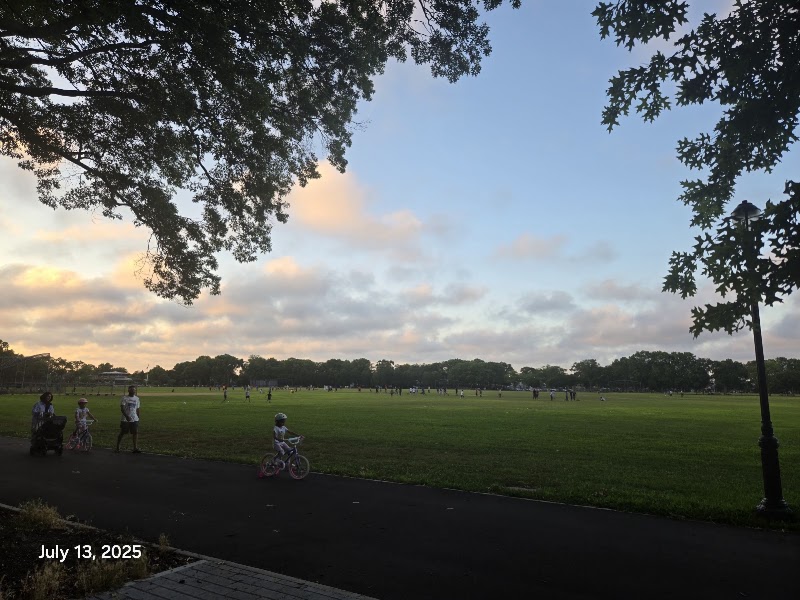
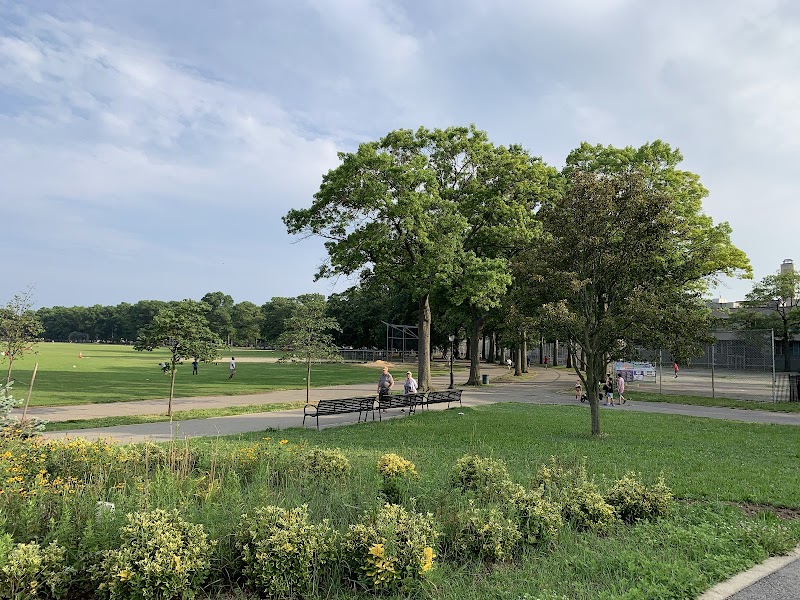
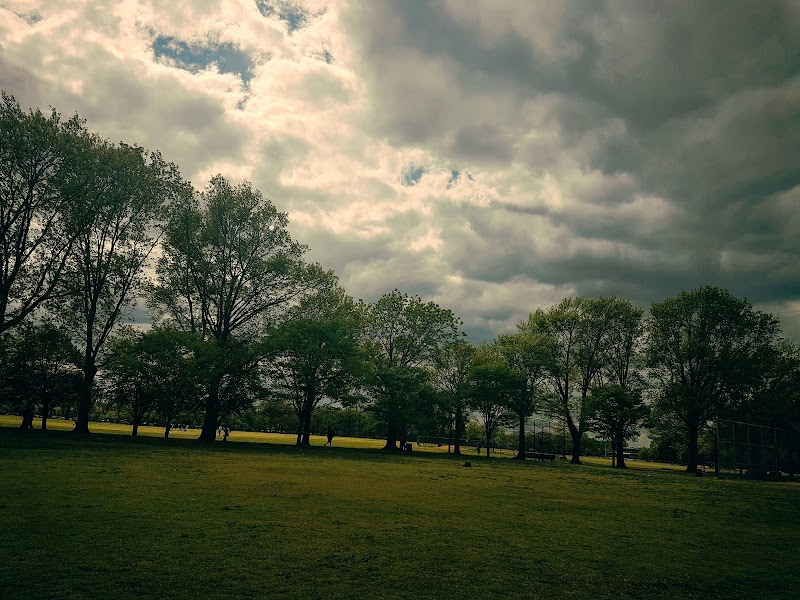
- The oval and the athletic fields — a walking-and-running oval of about eight-tenths of a mile ringing a huge playing complex of baseball, softball, soccer, cricket, football, tennis, handball, bocce and basketball.
- The Hendrick I. Lott House nearby — a Dutch colonial farmhouse with a 1720 wing and an 1800 main block, a designated New York City landmark and one of the borough’s most archaeologically important buildings.
What you’ll find
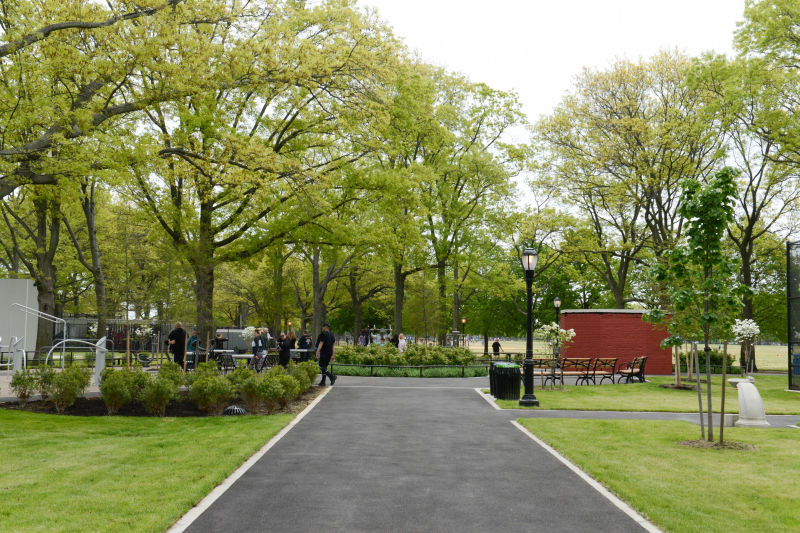
Think of the park as two landscapes sharing a name. North of the water sits the recreational grid — turf, clay, asphalt, floodlights, parking, a community center. South and west, the ground drops into marsh, mudflat, phragmites and open water, and the city noise falls away with it.
- The Salt Marsh Nature Center building with exhibits, restrooms and ranger programming, plus trailheads on the creek’s eastern side.
- Nature trails on both banks of Gerritsen Creek — the eastern loops are shorter and better maintained, the western routes longer and wilder, best walked at low tide.
- An extensive sports complex: baseball and softball diamonds, cricket pitches, soccer and football fields, tennis, handball, bocce, basketball and pickleball courts.
- The eighteen-hole municipal golf course with driving range, operating on its own season, hours and greens fees.
- The Carmine Carro Community Center, opened in March 2013, built with solar panels, geothermal heating and cooling and a green roof.
- Playgrounds with spray showers, community garden beds, a model-airplane flying field dedicated in 1971, parking lots and a bike rental concession.
Things to do — and who it’s for
- Birdwatchers — one of the strongest birding sites in Brooklyn, with nesting Osprey, Clapper Rail, Willet, Saltmarsh and Seaside Sparrows in summer, big shorebird movement in spring and fall, and waterfowl, loons and Northern Harrier in winter.
- Families with curious children — the Nature Center’s ranger programs turn a marsh walk into a lesson in horseshoe crabs, ribbed mussels and tides, at no cost.
- Walkers and runners — the oval gives you a flat measured circuit; the trails give you a genuine off-pavement hour with no traffic lights.
- Golfers — a full-length public course by a famous designer, unusual for an inner borough, with a range attached.
- League and pickup athletes — the sheer count of fields means cricket, soccer, softball and basketball all coexist here on a summer weekend without fighting for space.
- Photographers and quiet-seekers — low tide and late light over the creek produce the least urban-looking landscape in Brooklyn.
Getting there & practical
The park anchors the southeastern corner of Brooklyn in the Marine Park and Gerritsen Beach neighborhoods, facing Jamaica Bay. There is no subway station at the park, which is precisely why it stays quiet: the usual approach is the 2 or 5 train to Flatbush Avenue–Brooklyn College, or the Q to Avenue U, then a short ride on a local bus. The B3, B31, B41 and Q35 all serve the surrounding area, and the B3 drops you closest to the Nature Center. Entry to the park, the preserve and all trails is free; only the golf course operates on a separate fee and tee-time system, and the Nature Center’s programs are free but sometimes require signing up in advance. The park is open daily from early morning until one in the morning, while the Nature Center keeps shorter daytime hours and closes on some weekdays. Allow two hours for the trail and center, half a day if you are combining a walk with sport or golf, and check a tide table before you go.
When to visit
Spring is the birding peak and the marsh’s loudest season: warblers, tanagers and orioles pass through, and shorebirds work the flats. Summer belongs to the nesting birds — osprey on the platform, terns and skimmers foraging offshore — and to the fields and the golf course, though the marsh gets hot, buggy and best explored early in the morning. Autumn brings the second migration, cooler air, clean light and the cordgrass turning gold; this is arguably the best all-round month range for a first visit. Winter is stark and underrated: waterfowl, loons and grebes fill the open water, hawks and harriers hunt the grassland, the phragmites rattle, and you can walk for an hour meeting almost no one.
Good to know
Native people fished and hunted here for millennia — archaeologists working the creek have recovered food-preparation pits, animal bone, oyster shell and sturgeon scales dated roughly to 800–1400 AD, tied to the village recorded as Keshawchqueren. In the seventeenth century the Gerritsen family, Dutch settlers, built a tide mill on the creek that is described as the first of its kind in North America; it ground grain for roughly 270 years, stopped working around 1890, and was destroyed by an arsonist in 1935. Its pilings still show above the water at low tide. The modern park began in 1917, when Frederic B. Pratt and Alfred Tredway White jointly donated 150 acres to the city, with more land added by the Whitney family in 1920. By 1937, when the Board of Aldermen formally named it Brooklyn Marine Park, it had grown past 1,800 acres; more than half was later transferred to the National Park Service as part of Gateway National Recreation Area. The twentieth century was not kind in between: the creek’s upper reach was buried in a storm sewer in 1920 and much of the marsh was used as landfill, with trash piled sixty feet high in places. Restoration began seriously in the 1980s — the first nature trails were cut along Gerritsen Creek in 1984 and 1985 — and continued with a US Army Corps of Engineers ecosystem restoration funded in 2012 that stripped invasive growth, excavated fill and laid clean sand for native cordgrass; a grassland restoration on White Island, an artificial island built up from refuse, was completed in 2014. Just outside the park stands the Hendrick I. Lott House, whose oldest wing was raised by Johannes Lott around 1720 and whose main block was built by his grandson Hendrick I. Lott around 1800. The family freed nearly all the people they had enslaved by 1805, more than two decades before New York State abolished slavery in 1827, and excavations in the house uncovered concealed objects associated with African spiritual practice. It became a New York City landmark on 3 October 1989 and joined the National Register of Historic Places on 3 March 1994.
Visitor tips
- Check the tide before you leave. Low tide exposes the mudflats and brings out the wading birds, crabs and mill pilings; high tide hides most of it.
- Wear closed shoes and check for ticks after leaving the trails — this is real marsh-edge habitat, not a lawn.
- Go early for wildlife. Secretive marsh birds like Clapper Rail are far easier before the fields and paths fill up, and the light is better for photographs.
Questions & answers
Is Marine Park really the largest park in Brooklyn? Yes — at roughly 798 acres it is comfortably the borough’s biggest, larger than Prospect Park, though much of its area is protected marsh rather than lawn.
Is there an entrance fee? No. The park, the preserve, the Nature Center and all trails are free. Only the golf course charges, on its own greens-fee and tee-time system.
How long is the nature trail? The main loop behind the Nature Center is a comfortable stroll of under an hour; the park as a whole holds around fifteen miles of walking trails, so you can extend the walk considerably on the creek’s western side.
What wildlife will I actually see? Depending on season: egrets and herons, osprey, ducks and geese, cormorants, fiddler crabs, ribbed mussels, horseshoe crabs in early summer, cottontail rabbits, and — as an introduced, unwelcome species — mute swans.
Can I get there without a car? Yes, but not directly by subway. Take the 2 or 5 to Flatbush Avenue–Brooklyn College or the Q to Avenue U, then a local bus; the B3 stops nearest the Nature Center. There are also parking lots if you drive.
Is the golf course open to the public? Yes. It is a municipal eighteen-hole course with a driving range, open to anyone who books a tee time and pays the greens fee, entirely separate from park admission.
Is it suitable for small children? Very. There are playgrounds with spray showers on the recreational side, and the Nature Center’s ranger programs are designed for school-age children and families.
What happened to the old mill? Gerritsen’s tide mill, built by Dutch settlers in the seventeenth century and reportedly the first tide mill in North America, ceased grinding around 1890 and was burned by an arsonist in 1935. Its wooden pilings are still visible at low tide.
Can I visit the Hendrick I. Lott House? The city acquired the house in 2001 and it is being restored with the aim of opening as a historic house museum; access has been limited during the work, so check its current status before making a special trip.
Photos
Show 1 more photos
Visitor reviews
Reviews last updated: 2026-08-04 20:05:52
Data is refreshed monthly. Sources: brooklyn-name.com and editorial picks based on reviews.
Marine Park is a giant park with a playground and sports fields (mostly baseball), and a lot of camps come here in the summer. It's a great place to spend time with kids, and you can spend maybe a couple of hours here. T…
A peaceful, family-friendly place. Perfect for running and walking dogs. Well kept. People are polite. My daughter and I come here for a walk almost every day.
Brooklyn's biggest park and it doesn't feel like the city at all. The salt marsh trail is the move—herons, crabs, quiet water views. Main loop is solid for running or biking, plenty of fields for soccer and softball. Pla…
A nice and peaceful place to relax and enjoy nature in Brooklyn. The park is clean, spacious and perfect for walking, jogging, biking or spending time with family. The waterfront views are especially nice, and there's pl…
This is a nice park with lots of places to explore. We should have brought headlamps or something, because it gets dark fast here and there was still so much ground left. We found motorcycles and even a whole car, maybe…