

Park · Brooklyn · ⭐ 9.5/10 · 28491 reviews · updated: 2026-08-04 20:05:48
Address: Brooklyn, NY, United States
Prospect Park — the masterpiece Olmsted and Vaux rated above Central Park
Brooklyn’s great central park covers roughly 526 acres of meadow, woodland and water, and it is the park Frederick Law Olmsted and Calvert Vaux built after Central Park, using everything Manhattan had taught them. There they had been boxed into a long rectangle broken by a reservoir and sliced by cross-town traffic. Brooklyn handed them an unbroken site draped over a glacial ridge, and they answered with three landscapes laid end to end: a meadow nearly a mile long, a wooded ravine sheltering Brooklyn’s last old-growth trees, and a lake filling the southern end. Each dissolves into the next with no fence, no gate and almost no straight line. More than a century and a half later the pastoral illusion still holds. Stand in the middle of the Long Meadow, a quarter-hour’s walk from three subway lines and two million neighbors, and you can turn a full circle without seeing a single building.
Highlights
- The Long Meadow — around 90 acres running close to a mile from end to end, the longest unbroken stretch of meadow in any American urban park. Olmsted screened the edges with belts of trees so that the far end is never fully visible at once; the ground rolls, the horizon keeps retreating, and the effect is of open country rather than a lawn. Seven baseball diamonds share its southern half without ever dominating the view.
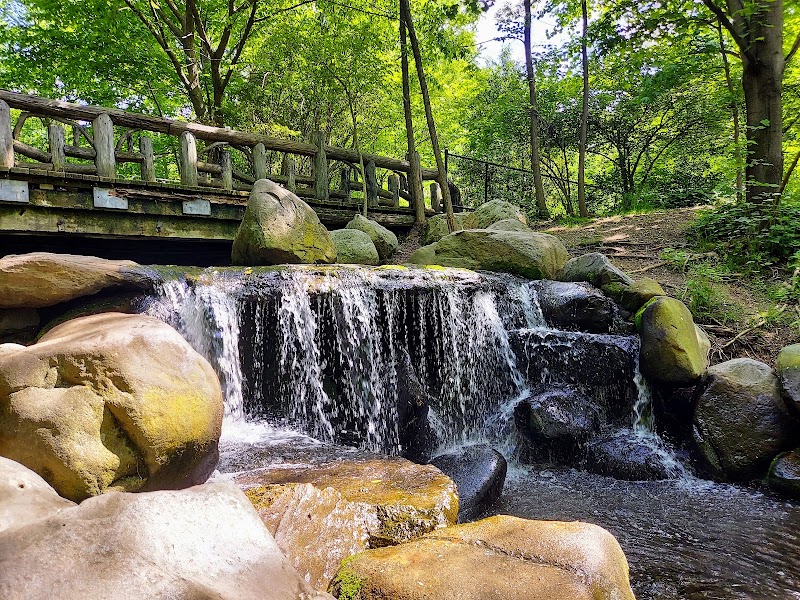
- The Ravine and the Midwood — a 146-acre wooded district holding the last remaining old-growth forest in Brooklyn. Almost everything in it that reads as wilderness is engineering: the gorge, the boulder outcrops, the pools and the waterfalls were all constructed. The Prospect Park Alliance has been repairing a century’s worth of erosion and soil compaction here since 1996, replanting nearly 200 acres of woodland.
- The watercourse — a manufactured stream that begins at Fallkill Falls, drops through the Upper and Lower Pools, tumbles down Ambergill Falls, gathers in the Binnenwater (Dutch for “within”), spills over Binnen Falls, then widens into the Lullwater and finally into the Lake. It was originally drawn from an underground aquifer through the Well House, and has run on the city water supply since around the turn of the twentieth century.
- Prospect Park Lake — 60 acres and the only lake in Brooklyn, shaped with a Peninsula, deep coves and low islands so that no single vantage point ever gives away its full size. Music Island, obliterated when a rink was dropped onto the historic shoreline in the 1960s, was rebuilt and rededicated in October 2012.
- The Boathouse — a white glazed terra-cotta pavilion of 1905 by Helmle and Huberty, its arcade of Tuscan columns modeled on the lower story of Sansovino’s Library of St. Mark in Venice and mirrored in the still water of the Lullwater. It came within forty-eight hours of demolition in September 1964; the outcry that saved it is one of the founding episodes of New York’s preservation movement.
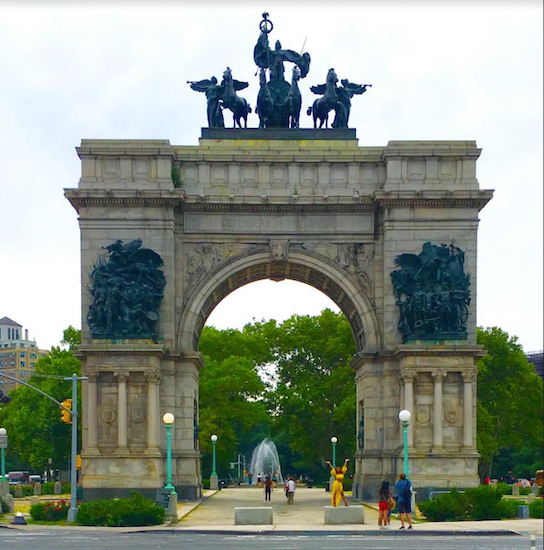
- Grand Army Plaza — the great oval Olmsted and Vaux laid out as the park’s ceremonial threshold, dominated by the Soldiers’ and Sailors’ Memorial Arch, designed by John H. Duncan and built between 1889 and 1892, with Frederick MacMonnies’s bronze quadriga hoisted onto its attic in 1898 and the Bailey Fountain completed in 1932.
What you’ll find
Prospect Park is not a single attraction but a whole landscape with buildings scattered through it — most of them landmarked, several of them older than the park itself, and a few, like the Boathouse and the Carousel, rescued from demolition by ordinary Brooklynites who refused to let them go.
- LeFrak Center at Lakeside — opened in December 2013 to a design by Tod Williams Billie Tsien Architects, replacing the Kate Wollman Memorial Rink that had opened in December 1961 on top of the original Olmsted and Vaux shoreline. Two connected rinks give some 32,000 square feet of ice in winter: one covered and open all year, one open-air and seasonal. In warm weather the covered rink becomes a roller rink and the splash pad opens as the park’s largest water play area.
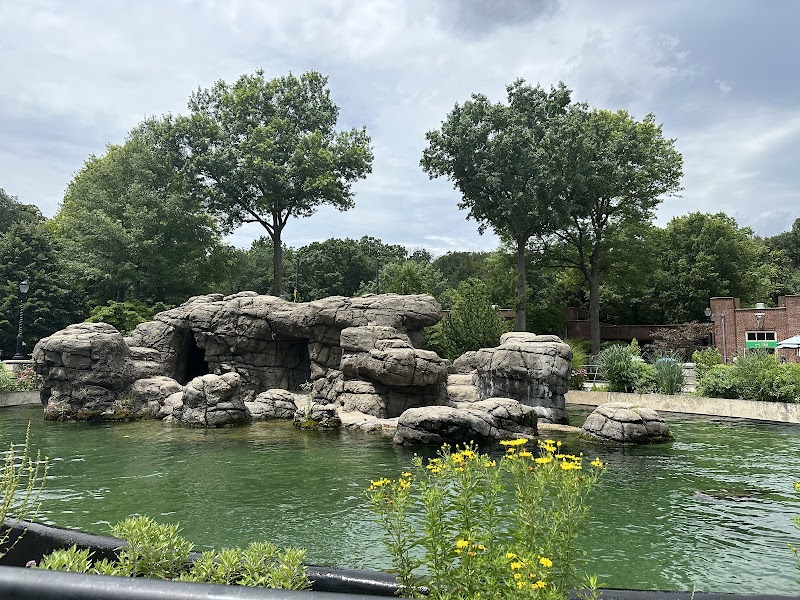
- Prospect Park Zoo — a menagerie stood here from 1890, but the zoo proper opened on 3 July 1935, built with Works Progress Administration labor to Aymar Embury II’s design: six red-brick pavilions with limestone trim curved around a courtyard, carrying bas-reliefs drawn from Kipling’s Jungle Book. Closed in 1988 and completely rebuilt inside its 1930s shells, it reopened on 5 October 1993 and is run by the Wildlife Conservation Society across about 12 acres.
- Lefferts Historic House — a Dutch Colonial farmhouse built by Peter Lefferts around 1783, moved bodily into the park in 1918 to save it from demolition and landmarked in 1966. Its museum now concentrates on the Lenape of Lenapehoking and on the people the Lefferts family enslaved.
- The Carousel — carved by Charles Carmel in 1912 and brought here from Coney Island in 1952: 53 horses plus a lion, a giraffe, a deer and two dragon-drawn chariots. Carmel learned his trade near the park’s own horse stables, and this is one of only about a dozen of his machines still turning anywhere.
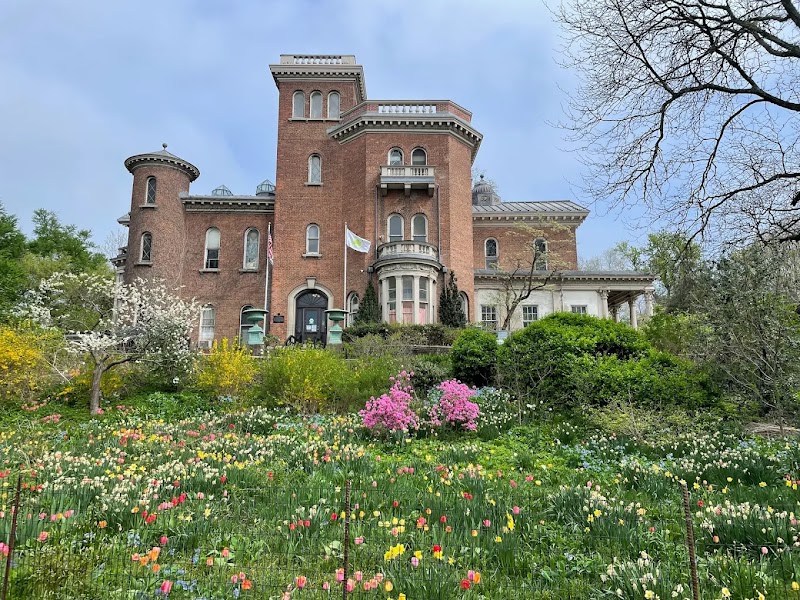
- Litchfield Villa — an Italianate mansion of 1854–1857 by Alexander Jackson Davis, built for the railway developer Edwin Clark Litchfield and named Grace Hill. The park swallowed the estate in 1869; since 1883 the villa has served the parks administration, and it now houses both the Brooklyn borough parks offices and the Prospect Park Alliance.
- The Concert Grove Pavilion — Calvert Vaux’s exuberant 1874 open-air shelter, long known as the Oriental Pavilion, mixing Hindu, Chinese, Moorish and Egyptian motifs under a star-shaped stained-glass skylight. Fire almost destroyed it in 1974; its cast-iron columns survived, it was restored in 1988, and it reopened again in April 2021 in its full original polychrome.
Things to do — and who it’s for
- Runners, cyclists and skaters — the 3.35-mile loop drive has been permanently car-free since 2 January 2018, the first time since the invention of the automobile that the whole circuit belonged to people on foot and on wheels. Its long climb up the eastern side is the closest thing central Brooklyn has to a hill workout.
- Birdwatchers — the park sits on the Atlantic Flyway and is a designated Important Bird Area; more than 250 species are recorded here in a typical year and close to 300 across the park’s history. The Peninsula, the Lullwater, the Ravine and the edges of the Nethermead are the classic beats, and the Audubon Center at the Boathouse runs walks in season.
- Families with young children — the Children’s Corner concentrates the Carousel, the zoo and Lefferts Historic House within a few minutes of each other, with the Lakeside splash pad and a string of playgrounds nearby. The zoo’s sea-lion pool, farm animals and Discovery Trail are pitched squarely at small visitors.
- Music, food and market people — the Lena Horne Bandshell has hosted BRIC Celebrate Brooklyn! every summer since 1979, New York’s longest-running free outdoor performing arts festival. On Breeze Hill, Smorgasburg sets out around a hundred food vendors on Sundays from April into late October, and the Saturday greenmarket runs at Grand Army Plaza.
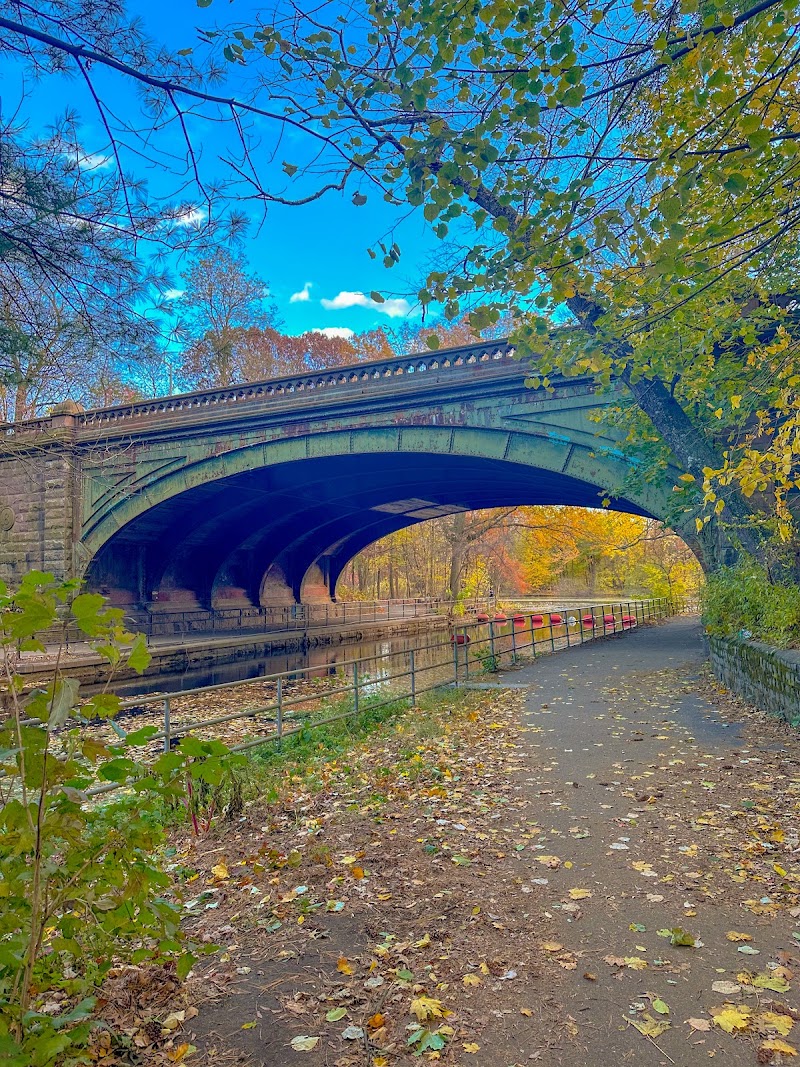
- History and architecture buffs — the arches and bridges alone repay a whole visit: Endale and Meadowport as dark tunnels opening onto the meadow, the triple-span Nethermead Arches over the watercourse, Esdale and Binnen in the woods, plus the Boathouse, the memorial arch, the Grecian Shelter of 1904 and the Tennis House of 1910.
- Picnickers, dog owners and drummers — the Long Meadow and the Nethermead absorb picnics, kites, cricket and pick-up football without feeling crowded; the park keeps designated early-morning and late-evening off-leash hours; and at Drummer’s Grove, where Afro-Caribbean drum circles have gathered since 1968 and which the Alliance formally recognized and rebuilt in 1997, the drumming runs Sunday afternoons from spring to autumn.
Getting there & practical
The park is ringed by neighborhoods that each treat it as their own back garden: Park Slope along the west, Prospect Heights at the north, Windsor Terrace and Kensington to the south-west, Prospect Lefferts Gardens and Flatbush to the east and south-east. By subway, the 2 and 3 stop at Grand Army Plaza for the northern entrance and the Long Meadow; the B and Q reach Prospect Park station, where the Franklin Av Shuttle also terminates, for the zoo, the Carousel and Lefferts; the Q continues to Parkside Av and Church Av for the Lake and Lakeside; and the F and G serve 15 St–Prospect Park and 7 Av on the western side. Several local bus routes circle the perimeter. Entry to the park is free and it is open daily from early morning until one in the morning; the Carousel, skating and rentals at the LeFrak Center, and the zoo are each ticketed separately. Allow at least two hours for the loop and a first look at the meadow, half a day to add the Ravine and the Lake, and a full day if you are bringing children through the zoo and Lakeside. The Brooklyn Botanic Garden, the Brooklyn Museum and the central library all stand just outside the park’s boundary, so it is easy to combine them.
When to visit
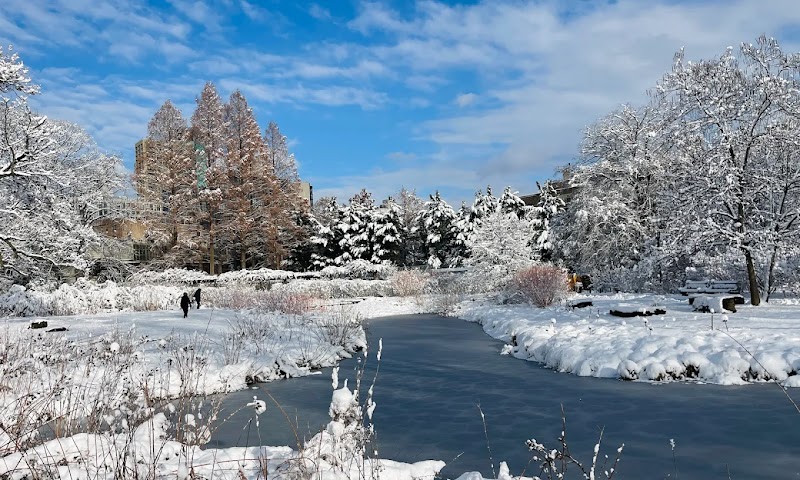
Spring is the connoisseur’s season: late April and early May bring the peak of songbird migration, when the Ravine and the Lullwater fill with warblers and the Brooklyn Bird Club’s regulars are out before breakfast, while magnolias and cherries come into flower and Smorgasburg and the drum circles both restart. Summer belongs to the crowds and the program — free concerts at the bandshell from June through August, roller skating under the covered rink, pedal boats on the Lullwater, the splash pad running, and the Long Meadow turned into one enormous shared back garden; the Ravine’s canopy is the coolest place in central Brooklyn on a heavy afternoon. Autumn is arguably the best light of the year: the Midwood and the Nethermead turn, the second wave of migration brings hawks and sparrows through, the crowds thin, and the low sun rakes across the meadow. Winter strips the park back to its bones, which is when the design becomes legible — bare trees reveal the arches, bridges and rock work that summer hides, waterfowl crowd the unfrozen parts of the Lake, and both rinks at Lakeside are running, one of them under the open sky.
Good to know
Brooklyn was still an independent city when the state legislature authorized a park here in 1859. The engineer Egbert Viele published a plan in 1861 for a “Mount Prospect Park” that would have been cut in two by a major thoroughfare and would have taken in the ground now occupied by the Brooklyn Museum, the botanic garden and the central library. James S. T. Stranahan, president of the park commission from 1860 to 1882 and universally called the father of the park, was unconvinced, and in early 1865 he had Calvert Vaux review the scheme. Vaux threw out the divided site and proposed instead the three regions that define the park to this day: meadow in the north and west, wooded ravine in the east, lake in the south. Olmsted rejoined him, the pair presented a revised plan in February 1866, it was accepted by May, and construction began that June with anything from 250 to 2,000 laborers on site depending on the season. The first section opened to the public on 19 October 1867; by 1868 the finished portions were drawing about 100,000 visits a month, and the work was substantially complete in 1873, when the financial panic of that year ended the partnership. The ground was already historic: on 27 August 1776 the Continental Army fought British and Hessian troops at Battle Pass during the Battle of Long Island, felling a great white oak — recorded as far back as Governor Thomas Dongan’s patent of 1685 — to block the road, and the survivors retreated across what is now the Long Meadow. A bronze eagle marking the Dongan Oak was dedicated on 25 November 1922, stolen in 1974 and replicated in 1991, while Stanford White’s Maryland Monument of 1895 on Lookout Hill honors the Maryland troops who covered that retreat. The park was designated a New York City scenic landmark on 25 November 1975 and listed on the National Register in 1980, but by then it was in deep trouble: a 1974 survey found that 44 percent of city residents would tell a visitor to stay away, and attendance bottomed out around two million in 1979. Recovery began when Tupper Thomas became the first Prospect Park administrator in 1980 and accelerated with the founding of the Prospect Park Alliance in April 1987, modeled on the Central Park Conservancy; the Carousel was its first capital restoration, and the woodland and watercourse work that began in 1996 has since put more than half a million trees, shrubs and plants back into the ground. Older layers survive throughout: the Quakers who sold the land kept about ten acres in perpetuity for a burial ground still closed to the public, where the actor Montgomery Clift was interred in 1966 in a grave his family asked never be identified; the Vale of Cashmere, named for a poem by Thomas Moore, still holds the balustraded basin McKim, Mead & White gave it in the 1890s and is being restored again now; and the weeping Camperdown Elm planted in 1872 survives largely because Marianne Moore wrote a poem about it in 1967 and called it the park’s crowning curio.
Visitor tips
- Come in from the Grand Army Plaza end and go through Endale or Meadowport Arch on purpose. Olmsted and Vaux built those tunnels dark and low so that the Long Meadow detonates in front of you as you step out; enter from the flanks and you lose the single best effect in the park.
- In the Ravine, pick up the watercourse at Fallkill Falls and simply follow the water downhill — through the pools, past Ambergill and Binnen Falls, along the Lullwater to the Boathouse. It is the only route that shows you what Olmsted and Vaux actually engineered, and the woodland paths are narrow, root-crossed and often wet, so wear real shoes.
- Sunday is the park at full volume: the drum circles at Drummer’s Grove from the afternoon, Smorgasburg on Breeze Hill from April to late October, and the loop drive thick with runners. If you want the Long Meadow and the Ravine to yourself, come on a weekday morning instead.
Questions & answers
Is Prospect Park bigger than Central Park? No. Central Park covers 843 acres; Prospect Park is about 526 by the city’s official count, though the Prospect Park Alliance reckons the working landscape at 585. Size was never the point — Olmsted and Vaux regarded the Brooklyn park as the better piece of design because the site let them build one continuous, uninterrupted composition.
Did the same people really design both parks? Yes. Frederick Law Olmsted and Calvert Vaux won the Central Park competition in 1858 and began Prospect Park in 1866, and the Brooklyn commission gave them a freedom Manhattan never did. Vaux drew the decisive revision in 1865, insisting the park should not be split by a road.
Are there cars inside the park? None. The full loop drive has been permanently car-free since 2 January 2018, after a car-free summer trial the previous year proved that recreational users vastly outnumbered drivers even in the rush hour.
Is the forest genuinely old, or was it planted? Both, in different places. The Midwood inside the Ravine district is the last remaining old-growth forest in Brooklyn. The gorge, boulders, waterfalls and stream running through it, however, are entirely man-made and have been fed from the city water supply for well over a century.
Can you swim or boat on the lake? Swimming is not permitted anywhere in the park. Boating is seasonal and runs from Lakeside in warm weather, and there is a splash pad there for children; in winter that same site becomes the skating rinks.
Is the Brooklyn Botanic Garden part of the park? No — the garden, the Brooklyn Museum and the central library are all immediately adjacent but outside the boundary. They occupy ground the discarded 1861 plan would have included, which is one reason that plan was abandoned.
Where should a birdwatcher start? The Peninsula and the Lullwater for waterbirds, the Ravine and the wooded edges of the Nethermead and Long Meadow for migrating songbirds. The park is an Important Bird Area on the Atlantic Flyway, over 250 species turn up in a typical year, and the Audubon Center in the Boathouse — the first urban Audubon center in the United States, opened on 26 April 2002 — is the natural starting point.
Can you skate here in summer? Yes. The covered rink at the LeFrak Center runs all year, carrying ice in winter and roller skating in the warm months, while the second, open-air rink is seasonal ice only. Skating and rentals are ticketed even though the park itself is free to enter.
How long does it take to walk round? The loop is 3.35 miles, which is an hour at a brisk pace on the paved drive. Add the Ravine, the Lullwater and the Lake shore and you are into two or three hours; with the zoo, Lefferts and Lakeside it becomes a full day out.
Photos
Show 1 more photos
Visitor reviews
Reviews last updated: 2026-08-04 20:05:48
Data is refreshed monthly. Sources: brooklyn-name.com and editorial picks based on reviews.
We were here on a school field trip; it's small in size, but there are all kinds of animals, mostly small ones: sea lions, a peacock, turtles, dingoes, monkeys, a red panda, a porcupine, a llama, a wild cat, a river otte…
A grand place for relaxing, sports, unwinding. Picturesque park scenery, a big lake with pedal boats, a baseball field, performance spaces, open lawns, interesting little corners of nature.
A fantastic park. You can run, rollerblade, bike and ride horses. Refined. Very clean. Sports events are held every week. Clean and luxurious restrooms. Fantastic air. There are lots of all kinds of places around. Very a…
Very pretty, there's room to walk, swans, herons, squirrels, ducks, an ice rink, I only found one restroom