

Park · Brooklyn · ⭐ 9.3/10 · 6900 reviews · updated: 2026-08-04 20:05:50
Address: Dekalb Avenue &, S Portland Ave, Brooklyn, NY 11205, United States
Fort Greene Park — a hill above Brooklyn where a war lies buried
Some thirty acres of sloping lawn, old shade trees and a broad summit rise straight out of the brownstone blocks of Fort Greene, and at the crest stands a granite column taller than almost everything around it. It is not ornament. Beneath its base lies a crypt holding the remains of American prisoners of war who died aboard British prison ships moored in Wallabout Bay between 1776 and 1783 — an estimated 11,500 people, more than died in all the battles of the Revolutionary War combined. This was Brooklyn’s first public park, laid out over the earthworks of a Revolutionary fort and redesigned by the same pair who shaped Central Park and Prospect Park. It still works two ways at once: a national memorial, and the everyday backyard of one of Brooklyn’s most walkable neighborhoods.
Highlights
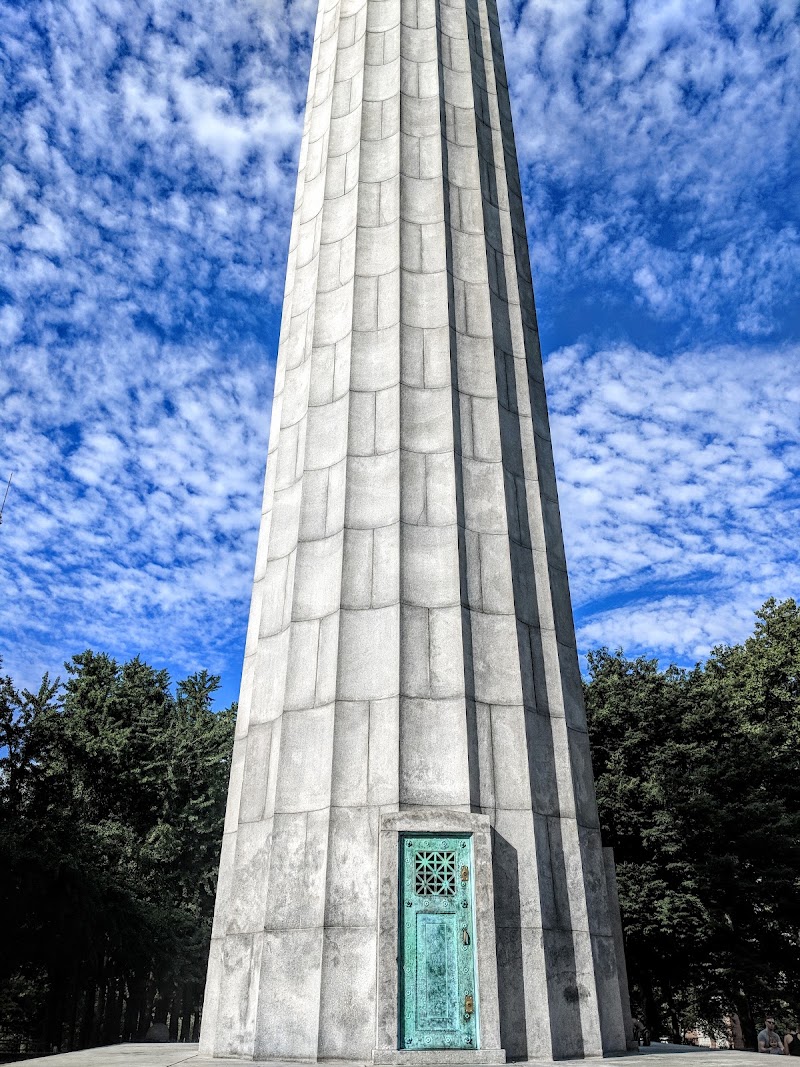
- Prison Ship Martyrs’ Monument — a Doric column of about 149 feet (roughly 45 m), designed by Stanford White of McKim, Mead & White and dedicated on November 14, 1908, with President-elect William Howard Taft delivering the principal address. It is commonly described as the tallest freestanding Doric column in the world.
- The crypt beneath the column — the recovered remains of the prison-ship dead were moved here in 1873 and rest in a vault under the monument’s base, in what period accounts describe as twenty-two boxes. The interior is not open for general access, though Urban Park Rangers occasionally lead scheduled visits inside.
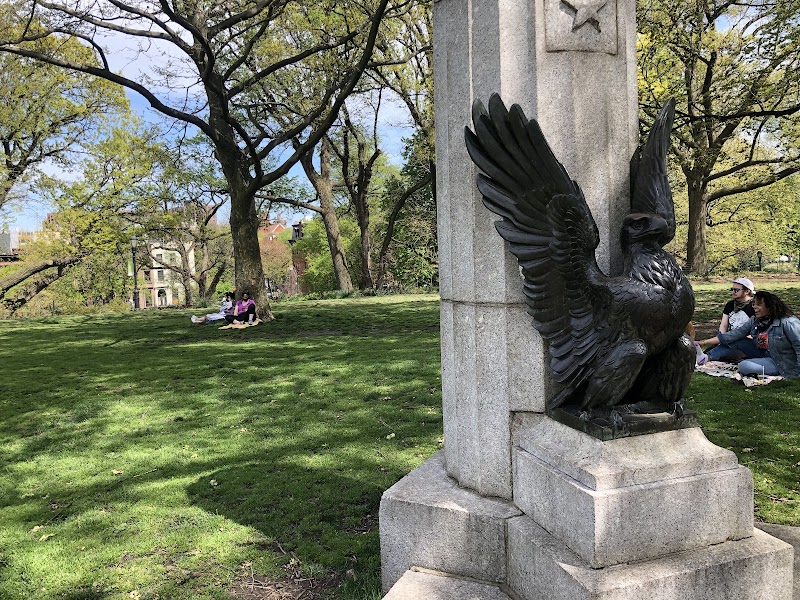
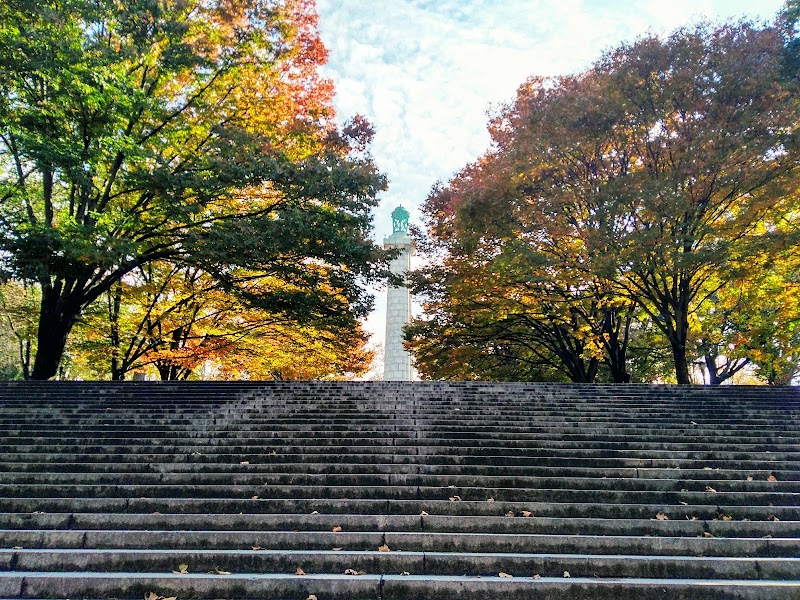
- The monumental stairway — a granite flight roughly 100 feet wide and 99 steps deep climbs to the summit plaza. Four bronze eagles by sculptor Adolph Weinman were set at its corners, and an eight-ton bronze brazier, shaped as a funeral urn, crowns the column.
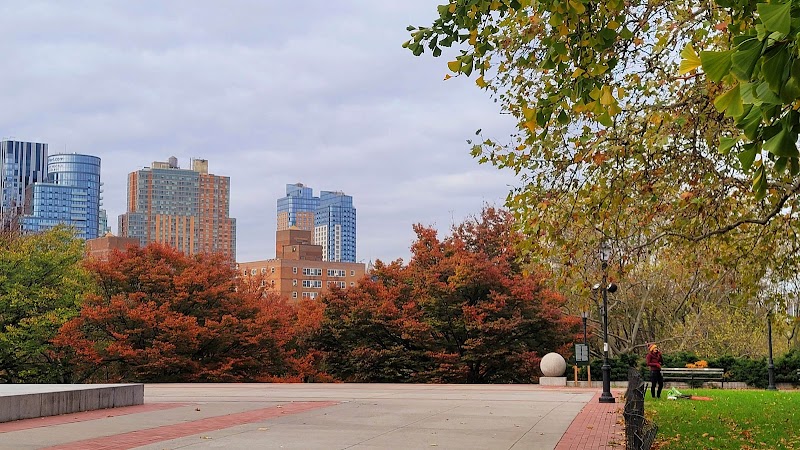
- The summit view — from the plaza the ground falls away toward Lower Manhattan and the Brooklyn Navy Yard, the very water where the prison hulks were anchored. On a clear day the skyline, One World Trade Center included, reads sharply across the harbor light.
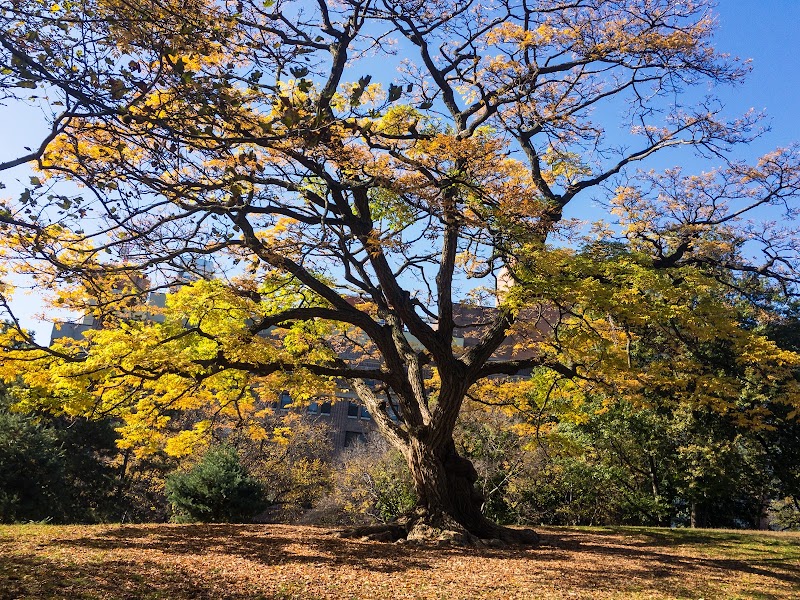
- The Olmsted and Vaux landscape — Frederick Law Olmsted and Calvert Vaux prepared their plan in 1867: winding walks, long open slopes, deliberate groves. A celebrated English elm on the park’s Tree Trail dates from that original 1860s planting and counts among the oldest and largest trees in Brooklyn.
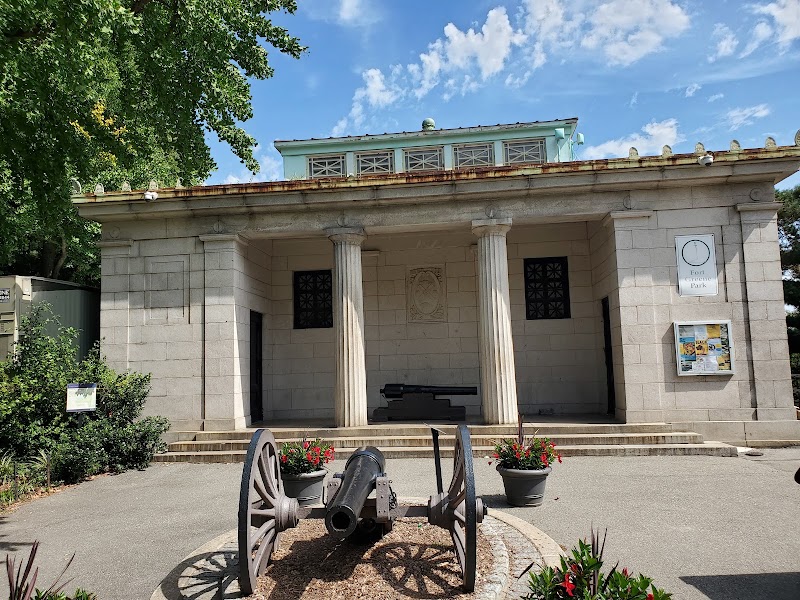
- The visitor center — a small neoclassical pavilion with clerestory windows and columned entrances, built as a comfort station when McKim, Mead & White reworked the hilltop; the firm was engaged in 1905 and the structures were complete by 1908. It now holds restrooms, park information and photographs of the crypt interior.
What you’ll find
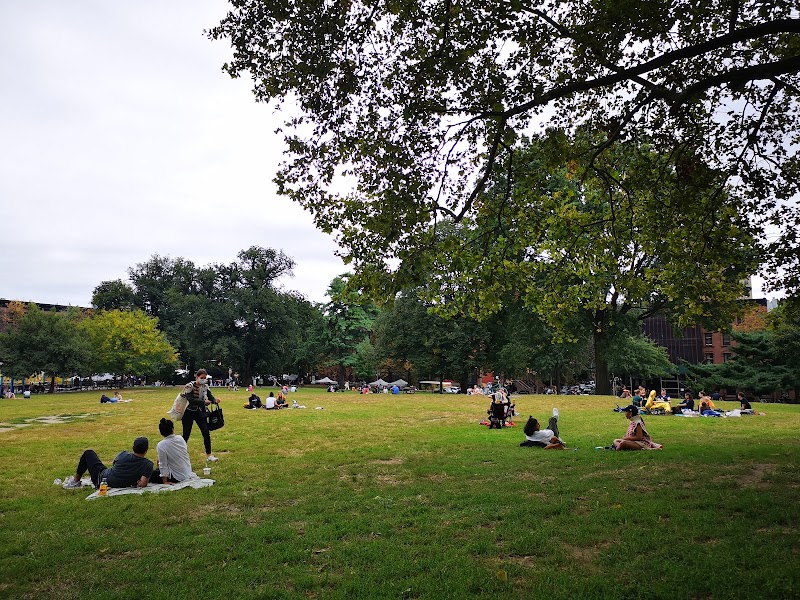
The park is essentially one large hill with a formal crown and informal sides. The ceremonial axis — stairway, plaza, column — occupies the summit; everything below is lawn, path, playground and court, arranged so that a war memorial and a Saturday picnic can share the same ground without either feeling out of place.
- Two playgrounds, the larger and busier one toward the northern side of the park.
- Six tennis courts, in season roughly April through November and run on the city’s permit system.
- Basketball courts plus open lawn used constantly for pickup games, sunbathing and drum circles.
- A signed Tree Trail introducing nineteen species out of the more than fifty growing in the park.
- A year-round Greenmarket on Saturdays along one edge, with regional farmers, bakers and growers.
- Barbecue and picnic areas, plus restrooms at the visitor center and near the northern playground.
Things to do — and who it’s for
- History travelers — one of the few places in New York where the Revolution stops being an abstraction: a fort site, a mass grave and a monument, all on one hill, within a hundred paces of each other.
- Families with young children — two playgrounds, gentle lawns for a first picnic, and a hill that toddlers treat as a personal summit to be conquered before lunch.
- Runners and stair trainers — the great flight and the looping paths make a compact, punishing circuit; regulars run stair repeats before the morning heat arrives.
- Dog owners — leashes are required from 9 a.m. to 9 p.m., with off-leash hours through the late evening and early morning; there is no fenced dog run, because historic-district protections limit new structures.
- Ukrainian- and Russian-speaking New Yorkers — a memorial built around prisoners of war, unburied dead and neighbors who gathered the bones themselves reads very differently to anyone who grew up with that kind of history closer to home.
- Culture-minded visitors — BAM, Brooklyn’s oldest performing-arts institution, and the Pratt Institute campus are both an easy walk away, and the park itself hosts a long-running summer literary festival, outdoor film nights and summer music afternoons.
Getting there & practical
The park sits at the heart of the Fort Greene neighborhood in Brooklyn, between downtown Brooklyn and Clinton Hill. The nearest subway is DeKalb Av, served by the B, Q and R; Atlantic Av–Barclays Ctr adds the 2, 3, 4, 5, B, D, N, Q and R and is roughly a ten-minute walk. Lafayette Av on the C, and Fulton St or Clinton–Washington Avs on the G, bring you in from the eastern side, and several Brooklyn bus routes stop along the perimeter. Entry is free and nothing inside requires a ticket or reservation; the grounds are open from six in the morning until one at night, and the visitor center keeps daytime hours seven days a week. Allow around forty-five minutes for a walk up to the monument and back down, or a full two hours if you add the Tree Trail, the Greenmarket and time sitting on the summit.
When to visit
Spring is the park at its most photogenic: elms and lindens leaf out, the slopes turn an improbable green, and the granite is finally dry enough to sit on. Summer is the loudest and most sociable season — literary readings, film nights, drumming and dancing across weekend afternoons, and shade that genuinely holds up under a July sun, though the treeless summit plaza turns fierce around midday. Autumn is the connoisseur’s season: clear air, the best skyline visibility of the year, and color running through the old plantings well into November, the month the monument’s dedication anniversary falls in. Winter strips the hill bare and hands you the view in exchange — the Manhattan skyline and the Navy Yard cranes stand out through leafless branches, the Greenmarket keeps trading in the cold, and the column against a low grey sky is the most sobering sight in Fort Greene.
Good to know
The hill was fortified in 1776 as Fort Putnam — named for Rufus Putnam, George Washington’s chief engineer — as part of the American defensive line that Nathanael Greene oversaw before the Battle of Long Island, also called the Battle of Brooklyn, fought on August 27, 1776. The Americans lost; New York fell; and the British converted decommissioned vessels into floating prisons in Wallabout Bay, the notorious HMS Jersey among some sixteen hulks. Prisoners called the Jersey “Hell Afloat”: built for a few hundred sailors, it held well over a thousand men at a time on rotten bread, fouled water and smallpox. Bodies went overboard or into the shallow shoreline, and for decades afterwards bones kept surfacing in the sand. In 1808 the Tammany Society collected what could be found into thirteen caskets, laid a cornerstone that April and held a reinterment that May before a crowd reported at fifteen thousand — yet the monument then promised was never built. When the works were rebuilt against a second British war, in the years around 1812, the site was renamed Fort Greene for the general. The city set the land aside for a park in 1845, with Walt Whitman campaigning for it from the editor’s desk of the Brooklyn Daily Eagle, and Washington Park opened in 1847 as Brooklyn’s first park. Olmsted and Vaux submitted their redesign in 1867, crypt included; the remains were moved into it in 1873, in twenty-two boxes. The park took the name Fort Greene Park in 1897, months before Brooklyn was consolidated into New York City. McKim, Mead & White were engaged in 1905, and the column rose over the crypt for the 1908 dedication. Gilmore Clarke reworked paths and plantings in the 1930s; the surrounding blocks were designated the Fort Greene Historic District in 1978; the monument was restored for its centennial in 2008. A city renovation plan first floated under the Parks Without Borders program in 2017 drew years of neighborhood opposition over tree removal, and the lawsuit brought by Friends of Fort Greene Park was dismissed on July 1, 2025, clearing the way for work that replaces dozens of trees — mostly invasive Norway maples — with some two hundred native ones, and adds accessible entrances, stormwater drainage and rebuilt courts.
Visitor tips
- Climb the great stairway rather than sliding in by a side path — the monument was designed to be met head-on and from below, and the whole effect collapses if you wander onto the plaza sideways.
- Come on a Saturday morning if you want the neighborhood along with the park: the Greenmarket runs year-round, and the hill fills with families within the hour.
- Check the Urban Park Rangers and Conservancy calendars before a history-focused visit — the crypt is normally closed, and the only way inside the monument’s base is a scheduled tour.
Questions & answers
Why is there a war monument in the middle of a neighborhood park? Because the park is also a burial site. An estimated 11,500 American prisoners of war died aboard British prison ships in Wallabout Bay, and the remains recovered from the shoreline were reinterred here in 1873; the column raised over them in 1908 is a memorial of national weight that happens to stand in a local park.
Is the figure of 11,500 reliable? It is the accepted estimate and the number the monument itself uses, drawn from period accounts rather than any complete register. Historians treat it as a floor as much as a ceiling, and some put the toll considerably higher. What is not disputed is the comparison: more Americans died in British captivity than in the fighting of the entire war.
Can you go inside the monument or the crypt? Not on an ordinary visit. The base and the crypt are closed to general access; Urban Park Rangers occasionally run announced tours that go inside, and the visitor center displays photographs of the interior year-round.
How tall is the column, exactly? Sources give about 148 to 149 feet, roughly 45 metres, with 149 the figure NYC Parks uses. It is generally described as the world’s tallest freestanding Doric column — a superlative for its architectural type, not a claim to be the tallest monument anywhere.
Who actually designed the park? Two hands, four decades apart. Frederick Law Olmsted and Calvert Vaux gave the hill its 1867 landscape of curving walks and open slopes; McKim, Mead & White, with Stanford White leading, imposed the formal stairway, plaza and column on the summit after 1905. The tension between picturesque and classical is still perfectly legible on the ground.
What did Walt Whitman have to do with it? He argued it into existence in print. Editing the Brooklyn Daily Eagle in the 1840s, Whitman pressed for the old fort site to be kept as public ground for a fast-growing city — one of the earliest American cases of a newspaper campaigning a park into being.
Is the park under construction right now? A long-delayed capital project, first proposed in 2017, is proceeding after the legal challenge against it was dismissed in July 2025. Expect fenced work zones, tree removal and replanting, and new accessible entrances toward the northern side; the monument, the hill and the main lawns stay open throughout.
Is it worth a trip if you are not a history reader? Yes — it is one of the best free skyline viewpoints in Brooklyn, with courts, playgrounds and a market attached, and the history reaches you anyway from the top of the stairs.
Photos
Show 1 more photos
Visitor reviews
Reviews last updated: 2026-08-04 20:05:50
Data is refreshed monthly. Sources: brooklyn-name.com and editorial picks based on reviews.
Fort Greene Park is a beautiful urban oasis in the very heart of Brooklyn, offering the perfect blend of history, nature and community. With its tree-lined paths, open green spaces and historic landmarks, it's an ideal p…
Free public park and hours: Fort Greene Park is an NYC Parks public property (admission is free). The park grounds generally operate on the NYC Parks schedule (early morning → late evening; see the Parks page for exact o…
What a peaceful place!
I discovered this park right after the New York Marathon, and it was such a big surprise. In the fall it's simply stunning — the colors, the atmosphere, everything! You can enjoy plenty of activit…
I always have a good time at Fort Greene Park. I usually come for events. This time it was Soul Summit. Nothing but peace, love and harmony. The park has a bunch of different areas. Kids' swings, benches. You can bring a…
It was my first visit to this park, and it was worth it. The park has plenty of space to relax, a playground, a basketball court and tennis courts. The park is located in a lively downtown area, so you'll have access to…