

Park · Brooklyn · ⭐ 9.1/10 · 4688 reviews · updated: 2026-08-04 20:05:53
Address: Jackie Robinson Pkwy, Brooklyn, NY 11208, United States
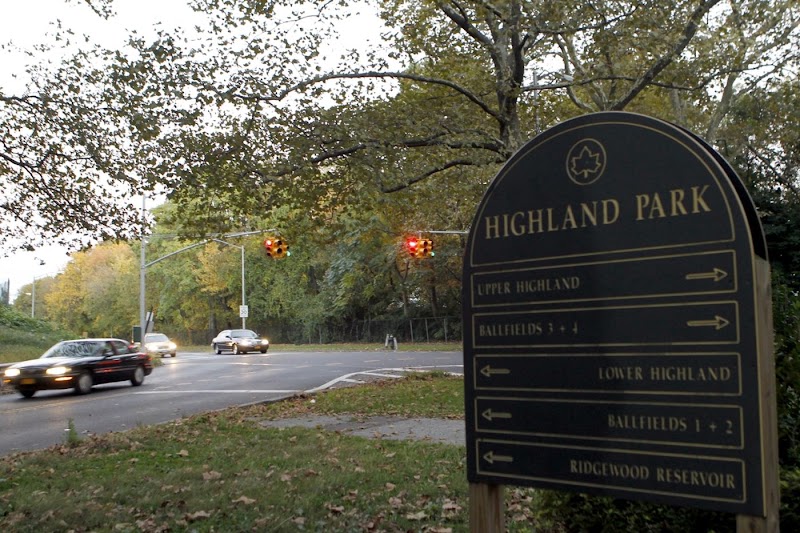
Highland Park — the glacial ridge and the reservoir that turned into a forest
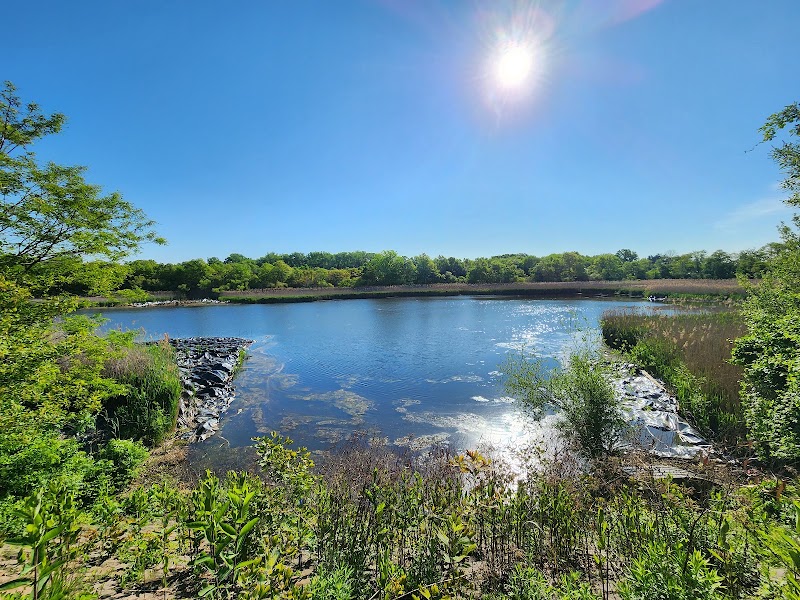
Brooklyn ends here, and Queens begins, along a ridge of gravel and sand that a glacier dropped about twenty thousand years ago. Highland Park runs along the top of it — roughly 141 acres split into a busy lower park of courts, fields and playgrounds, and an upper park that holds one of the strangest landscapes in New York City: the Ridgewood Reservoir, three vast stone-walled basins built in the 1850s to water the City of Brooklyn, emptied in 1989, and left alone long enough to become woodland, swamp and pond. Nobody planted it. It planted itself, and the state now protects it as wetland.
Highlights
- The Ridgewood Reservoir — about 50 acres in three basins, walled in stone, now filled with closed forest, scrub, swamp and standing water; roughly 156 bird species and 175 plant species have been recorded inside it.
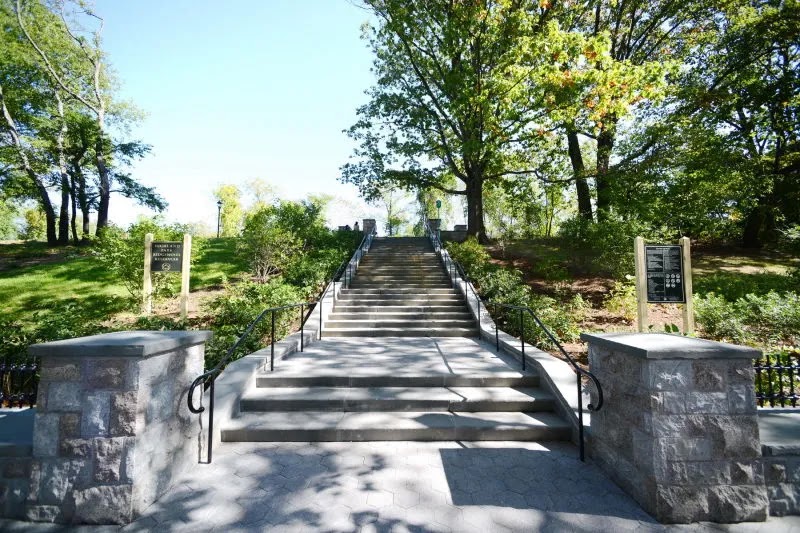
- The perimeter path — a level walking and cycling loop around the basin rims with overlooks into the drowned forest, linking into the Brooklyn–Queens Greenway that runs about forty miles across the two boroughs.
- The Children’s Garden — a working teaching garden that revives a children’s farm the Board of Education ran on this site from 1907 into the 1960s, brought back by local schoolchildren and volunteers at the end of the 1980s.
- The Cypress Hills ridge — the terminal moraine of the Wisconsin ice sheet, rising above the flat coastal plain of southern Brooklyn and southern Queens, with ridge elevations averaging around 92 feet.
- “The Dawn of Glory” — Pietro Montana’s First World War memorial, dedicated in 1925, one of the borough’s more dramatic public sculptures.
- The tennis complex — courts terraced into the ridge in the lower park, with ten full-size courts plus a set of youth courts, among the largest public tennis facilities in eastern Brooklyn.
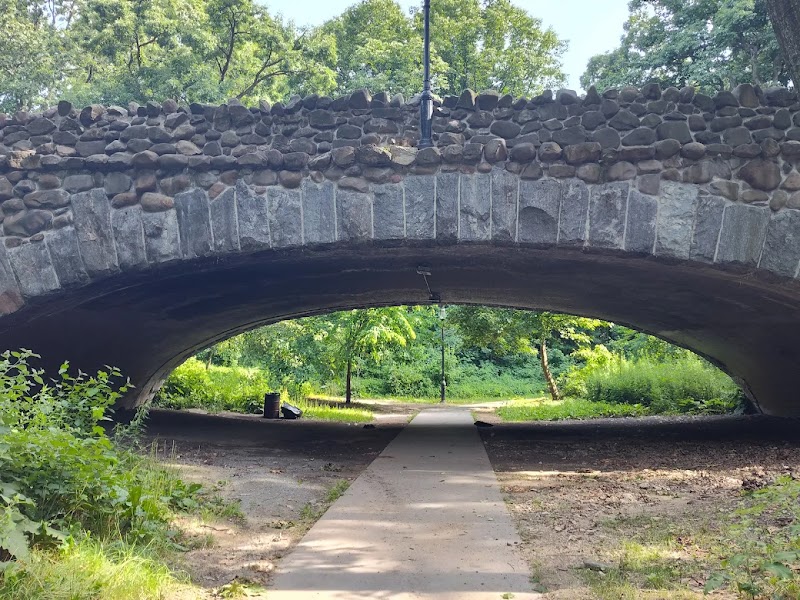
- The 1902 stone bridge — a survivor of the park’s first construction campaign, still carrying walkers in the upper park.
What you’ll find
The park is layered rather than laid out. The lower half is a conventional, hard-used neighborhood park; the upper half is a plateau of woods, paths and the reservoir basins, with cemeteries pressing against its edges and the land falling away in every direction.
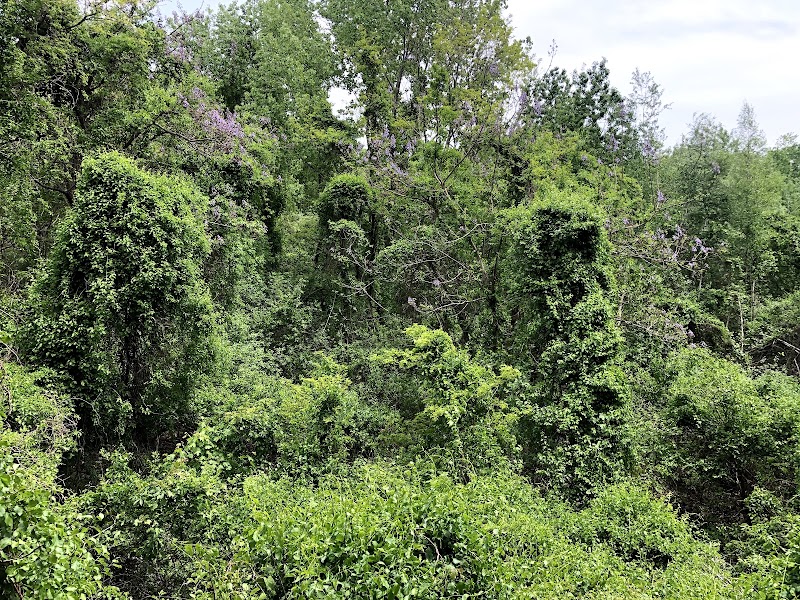
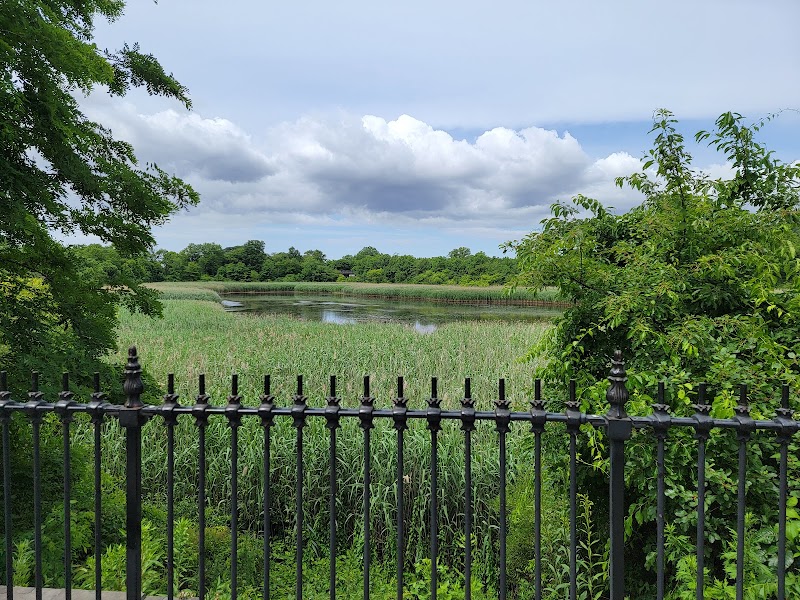
- Three former reservoir basins: the center one holding a pond ringed with phragmites, the east and west basins grown over into dense woodland, scrub and vine.
- A paved perimeter loop with viewing points, benches, fencing and lighting installed in the renovation completed in 2013, plus stone paths threading one of the basins.
- A restored gatehouse between two of the basins, converted into a ranger station.
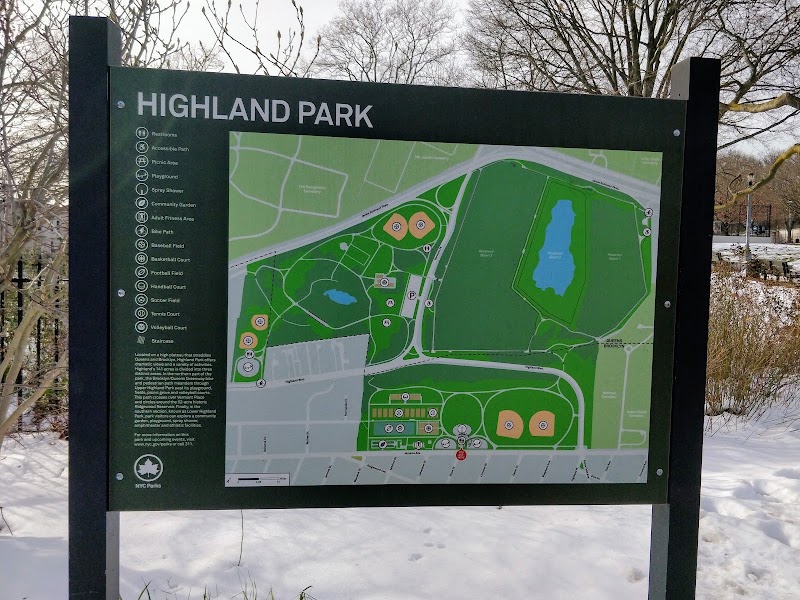
- Tennis courts, baseball fields, basketball and volleyball courts, a skate area and playgrounds across the lower park.
- Picnic areas with barbecue grills, shaded lawn and an off-leash dog area during designated hours.
- The Children’s Garden, planted beds and mature woodland on the plateau, with paths that stay usable in all seasons.
Things to do — and who it’s for
- Birdwatchers — the reservoir basins concentrate migrants in a way little else in eastern Brooklyn does, and the count of recorded species is high for a site this size.
- Walkers and cyclists — a flat, car-free loop with real forest on one side, and a direct connection onto the Brooklyn–Queens Greenway if you want to keep going.
- Families — playgrounds, spray features, grills and picnic lawns in the lower park, plus the Children’s Garden for kids who want to put their hands in soil.
- Tennis players — a large public court complex terraced into the hillside, rarely as oversubscribed as the courts closer to central Brooklyn.
- Geology and history walkers — you can literally stand on the terminal moraine and see how the ridge divides the flat outwash plain from the rest of the city.
- Anyone tired of manicured parks — the reservoir is a rare place where the city has simply let a landscape do what it wanted for three decades.
Getting there & practical
The park sits on the Brooklyn–Queens line, with Cypress Hills and East New York below it in Brooklyn and Ridgewood and Glendale on the Queens side. The J train serves it best: Cleveland Street and Norwood Avenue are both short walks to the lower park, and the C train at Euclid Avenue is another workable approach. Local buses including the B13, Q24 and Q56 run along the park’s edges, and the Q56 in particular tracks the southern boundary. Entry is free at all hours, with no gate and no ticket anywhere in the park or the reservoir area. The park is open daily from early morning until one in the morning, but the upper park and reservoir paths are best treated as daylight territory — there is little lighting inside the woods and the loop is genuinely remote in feel. Allow an hour for the reservoir loop alone, two or three if you are walking the whole park.
When to visit
Spring is the reason serious birders come: migration moves through the basins from April into May, and the woodland leafs out over standing water. Summer is the park’s social season — grills going, courts full, the Children’s Garden producing — though the reservoir woods get thick, humid and mosquito-heavy, so morning is better than afternoon. Autumn is the single most photogenic stretch, when the self-seeded forest inside the stone walls turns and you get the surreal sight of fall color sunk below a reservoir rim. Winter opens the view: leaves down, the basin structure visible, waterfowl on the pond, and the ridge exposed enough that you understand the geography at a glance.
Good to know
The reservoir came first. Ground was broken on 11 July 1856 in a hilltop cornfield on the Brooklyn–Queens boundary, and water was first raised on 18 November 1858; engineer James P. Kirkwood revised the original three-basin scheme to build two basins first, with the third completed in 1891. The system fed the growing City of Brooklyn from wells and ponds out on Long Island. The park grew around it: the City of Brooklyn bought the surrounding land in 1891 under the Highland Park Society, the park was established in 1901, and between 1901 and 1905 the Brooklyn parks department added roads, footpaths, structures, a rustic bridge, a flower garden and a lake with a fountain. The Schenck estate was added in 1905 and a third parcel from the water department in 1906; an aquatic garden followed in 1907 and children’s farm gardens in 1915. Pietro Montana’s First World War monument “The Dawn of Glory” was dedicated in 1925, and in 1991 the park’s western section was renamed Vito P. Battista Playground. The reservoir’s decline was slower: once the Catskill and Delaware systems reached the city it was demoted to backup in 1959, drawn on for the last time during the drought of the 1960s, finally decommissioned and drained in 1989, and transferred to the parks department in 2004. In those years nature took the basins back completely. The site joined the National Register of Historic Places on 2 February 2018, New York State’s environmental agency designated it a Class I freshwater wetland on 23 December 2018 — the strongest wetland protection the state gives — and the parks department named it a Critical Environmental Area in January 2019. A major renovation completed in October 2013 added accessible and bicycle-friendly paths, new fencing and lighting, stone paths through one basin, and turned the old gatehouse between two basins into a ranger station.
Visitor tips
- Walk the reservoir loop clockwise from the lower park so the climb comes first and the overlooks come as a reward rather than a warm-up.
- Bring binoculars in spring and autumn — most of what makes this site remarkable is inside the basins, below the rim and behind a fence, and the naked eye misses it.
- Treat the upper park as a daytime destination and go with company if you are walking the wooded sections; the paths are well kept but the woods are genuinely dense and quiet.
Questions & answers
Can you go down into the Ridgewood Reservoir basins? No. The basins are fenced and protected as wetland; you walk the rim path and look in from overlooks and viewing points. That protection is exactly why the interior has stayed intact.
Is the park in Brooklyn or Queens? The park proper is in Brooklyn, but it sits directly on the border, and the reservoir straddles the line — it was built by Brooklyn on ground that is now on the Queens side of the boundary.
Is there an entrance fee? No. The park, the reservoir paths and the Children’s Garden are all free and open to the public, daily from early morning until one in the morning.
When did the reservoir stop supplying water? It was reduced to a backup in 1959, used for the last time during the drought years of the 1960s, and finally drained in 1989. The parks department took it over in 2004.
What is actually growing inside it now? Closed forest, scrub, woodland and vine in the east and west basins, and a pond surrounded by phragmites in the center basin — around 175 plant species and 156 bird species have been recorded there.
Can I cycle here? Yes. The perimeter path is bike-friendly and connects to the Brooklyn–Queens Greenway, a route of roughly forty miles linking parks across the two boroughs.
What is the Children’s Garden? A teaching garden that revives the children’s farm the Board of Education ran on this site from 1907 until the 1960s. It was cleared and replanted at the end of the 1980s by local schoolchildren working with volunteers and agricultural extension staff.
Why is the land so high here? The park sits on the terminal moraine left by the Wisconsin ice sheet roughly twenty thousand years ago — the same ridge that carries Green-Wood Cemetery, Prospect Park and Forest Park — rising above the flat outwash plain of southern Brooklyn and Queens.
Photos
Show 1 more photos
Visitor reviews
Reviews last updated: 2026-08-04 20:05:53
Data is refreshed monthly. Sources: brooklyn-name.com and editorial picks based on reviews.
Although it doesn't feel like clean asphalt, the Highland Park reservoir loop is bliss on my skateboard. From Vermont and Highland, heading east, it can be a bit noisy, as can Vermont itself, but all the other stretches…
The Brooklyn–Queens border, it feels like a separate story. Ridgewood Reservoir is the thing to see: birches, birds, trails looping around it. Great for a run or just for taking in the skyline through the trees. Grills,…
I rode there on my bike from Brownsville. I was pleased with this beautiful place. It's a nice spot for walking, biking and running.
I was surprised to see so much greenery in the park. It offers an escape from city lif…
Over the weekend I took a walk through the park by the Jackie Robinson Parkway in Brooklyn. It's a very quiet and clean place. Lots of greenery, well-kept paths and almost no trash. There weren't many people, so it was e…
Such a nice park to spend time in with family, kids or friends. It's a shame the park is becoming a place where teenagers and adults can ride motorcycles where children play or ride. I had such a bad and frightening expe…