

Park · Brooklyn · ⭐ 9.7/10 · 43160 reviews · updated: 2026-08-04 20:05:47
Address: Brooklyn, NY 11201, United States
Brooklyn Bridge Park — eighty-five acres of working waterfront rebuilt as landscape
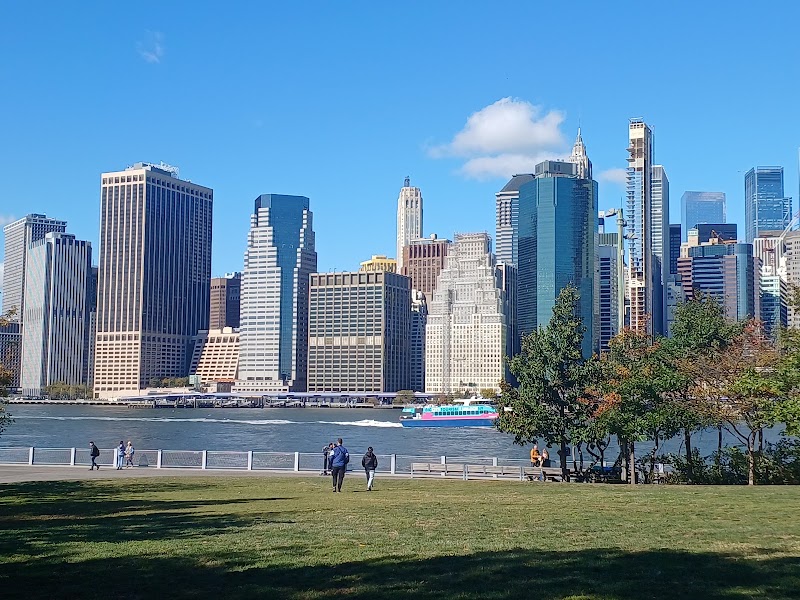
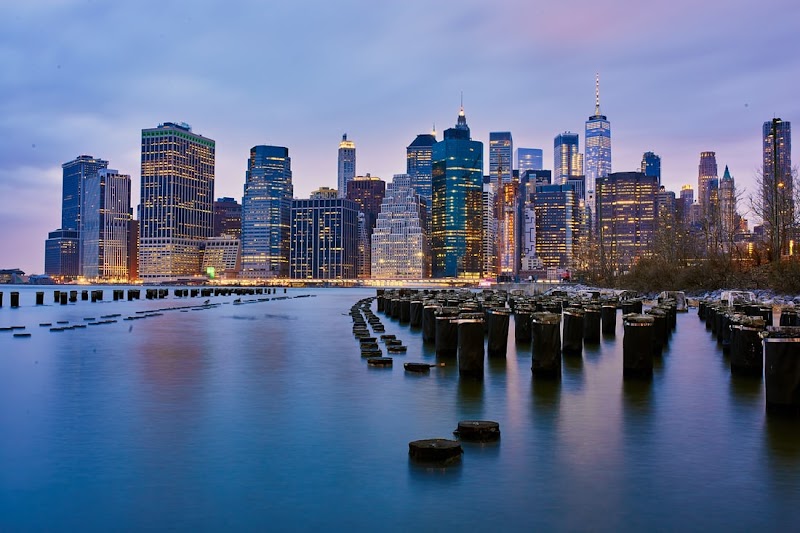
For most of the twentieth century this was a place you were not welcome. A mile and a third of bulk-cargo piers, cold-storage sheds and coffee warehouses turned their backs to the East River, fenced off from the neighborhoods on the bluff above. Today it is the most ambitious piece of landscape architecture built in Brooklyn in over a century — eighty-five acres running from the foot of Brooklyn Heights, under the Brooklyn Bridge, past the Manhattan Bridge and into DUMBO. Michael Van Valkenburgh Associates did not tidy the ruin so much as re-use it: the piers kept their footprints, the shed skeletons kept their steel, granite from demolished city bridges was rebuilt into steps you sit on, and hills raised from railway-tunnel spoil now stand between the lawns and the expressway. Roughly five million people come each year, a third of them from the surrounding blocks, and they come for the same reason: the harbor is suddenly right there. Lower Manhattan across the water, the Statue of Liberty down the bay, and the bridge towers overhead close enough to read the stonework.
Highlights
- Granite Prospect — a broad stepped terrace at Pier 1 built from more than 300 pieces of granite salvaged from the reconstruction of the Roosevelt Island Bridge. It works as an amphitheater aimed at the harbor, and on a clear evening every step is occupied.
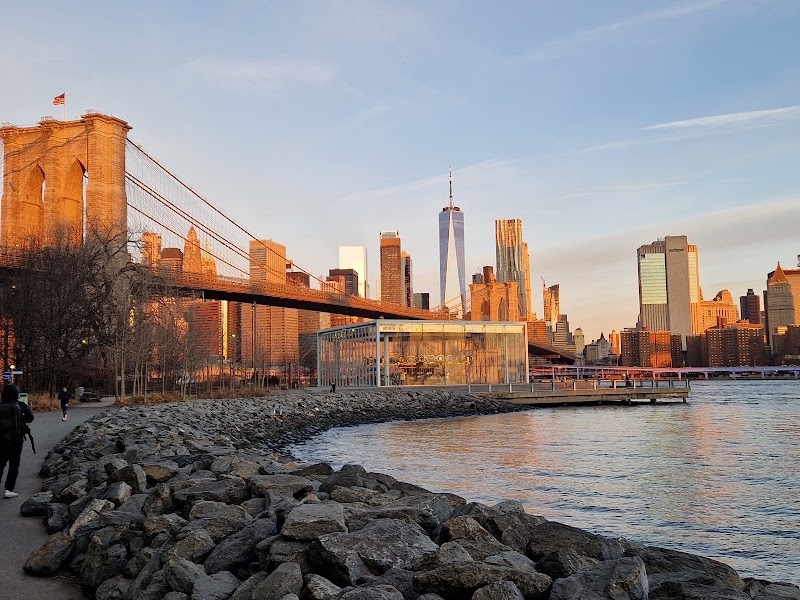
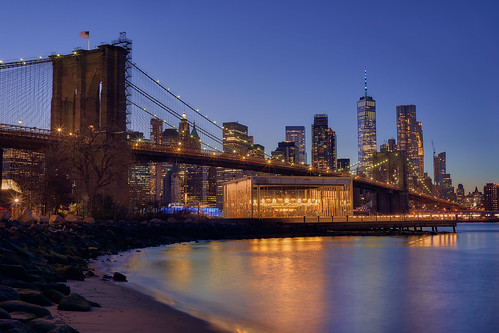
- Jane’s Carousel — a three-row 1922 machine by the Philadelphia Toboggan Company, PTC No. 61, with 48 hand-carved horses and two chariots by the carvers John Zalar and Frank Carretta. It spent its working life at Idora Park in Youngstown, Ohio, and now turns inside a luminous acrylic-and-steel pavilion designed by the Pritzker laureate Jean Nouvel.
- Squibb Park Bridge — a zigzagging pedestrian span dropping from Brooklyn Heights down into the park, roughly 400 feet long and some 50 feet above the roadway it crosses. Rebuilt in steel after the famously bouncy timber original was taken down, it reopened on 4 May 2020 and gives one of the finest free viewpoints of Lower Manhattan in the city.
- Pier 2 recreation deck — five acres of courts and play sheltered under the preserved steel skeleton of the old cargo shed: basketball, handball, ping-pong, pickleball, swings, fitness bars and a covered rink that rolls in summer. It is the only place in the park where you can finish a game in the rain.
- The Labyrinth at Pier 3 — a hedge maze seeded with strange devices: a walk-in kaleidoscope, mirrored games, echo tubes, dance chimes and parabolic reflectors that let two people whisper across a lawn, with salvaged bollards, cleats and railroad track from the pier’s cargo years worked into the paths.
- Pier 4 Beach and Bird Island — a small pebble beach with engineered tidal pools built to imitate a rocky coast, facing an offshore preserve raised on the remains of a railroad transfer bridge and planted with salt-tolerant shrubs and grasses. An osprey platform stands on it; people are not allowed, which is the point.
What you’ll find
The park reads as a chain of very different rooms strung along the river, each one shaped by whatever the shipping industry left behind. Walking north to south you pass through post-industrial marshland, a plaza directly under the Brooklyn Bridge, a lawn framed by Civil War-era warehouses, and then the piers themselves, which grow steadily more athletic as you go.
- Pier 1 — the largest section at about nine and a half acres, with Harbor View Lawn, Bridge View Lawn and the sheltered hollow called the Vale, a native salt marsh along its southern edge, more than 500 trees, water gardens of pussy willow, serviceberry and iris, and a 2025 entry pavilion by Tod Williams Billie Tsien Architects roofed in photovoltaic shingles.
- Piers 2 and 3 — sport and stillness side by side: the covered courts and rink on one, and on the other a wind-sheltered central lawn, a hardscaped plaza that skateboarders have claimed, moveable Adirondack chairs among the tree groves, and the Labyrinth along the northern flank.
- Piers 4, 5 and 6 — the beach and its tidal pools; three turf fields laid out for soccer, lacrosse, rugby, flag football and ultimate; the Picnic Peninsula, the park’s largest grilling ground, with salvaged-wood tables under weather-resistant umbrellas; a sheltered marina in what is described as the calmest basin in New York Harbor; and at the far end four themed playgrounds, three regulation sand volleyball courts, a dog run and a half-acre flower field.
- Empire Fulton Ferry — the green heart between the two bridges, holding Jane’s Carousel, the picnic lawn, and a boardwalk that is probably the single most photographed stretch of Brooklyn.
- Emily Warren Roebling Plaza — two acres directly beneath the Brooklyn Bridge, paved in concrete units that echo the bridge’s own geometry, with a salvaged stone lintel from a 1936 warehouse set into a planting bed. In winter it becomes an ice rink.
- The northern marsh sections — footbridges over a tidal channel that lets the East River run into the park, a gathering lawn of some 13,000 square feet, a nautical playground with pirate-ship rigging, one of North America’s largest outdoor bouldering walls, and an Environmental Education Center in a restored industrial building with hands-on exhibits about the park’s plants and animals.
Things to do — and who it’s for
- Families with small children — four playgrounds cluster at Pier 6 alone: Swing Valley with a swing for every size, Sandbox Village with one of the city’s largest sandboxes, Slide Mountain with its long metal chute, and the Water Lab, switched on once daytime temperatures settle in the eighties. Add the carousel and a nautical playground at the north end and a whole day disappears.
- Team-sport players and runners — turf fields at Pier 5 run first-come, first-served whenever leagues are not booked, with a one-hour courtesy limit when others are waiting; Pier 2 covers basketball, handball and paddle sports; a thirty-foot-wide perimeter promenade gives runners an unbroken riverside loop, and a weekly community run of a little over three miles starts at the southern end.
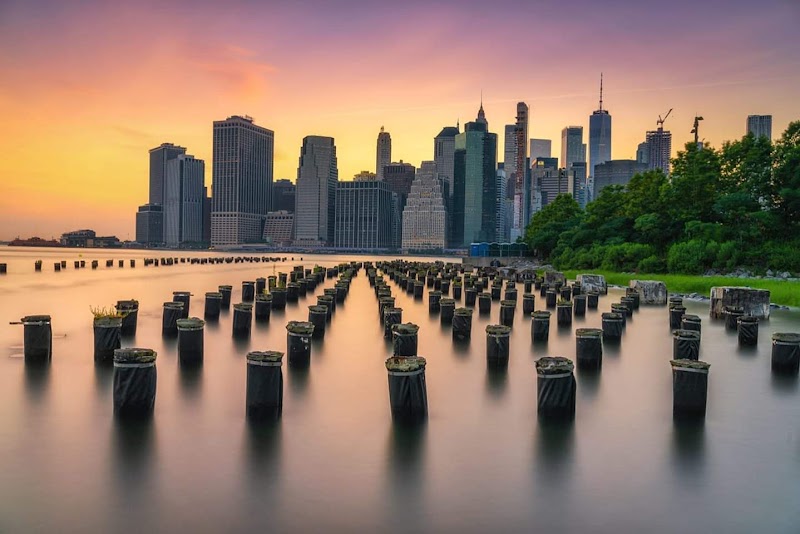
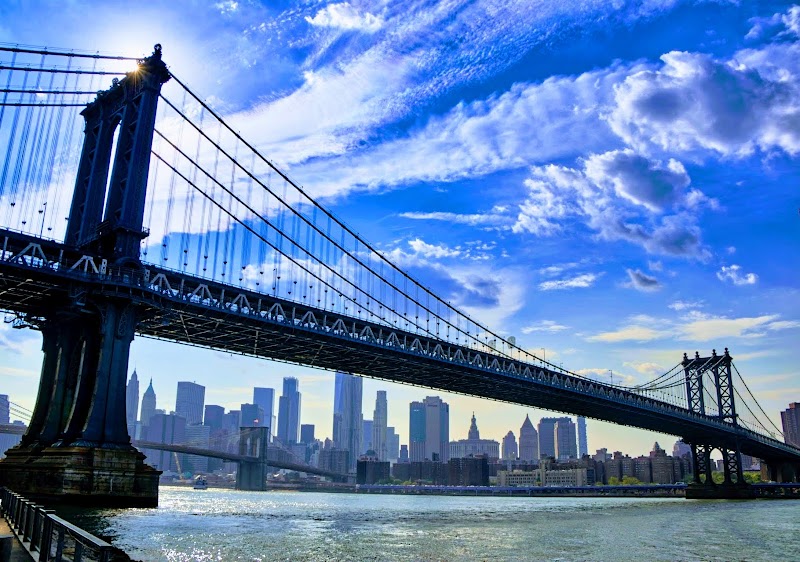
- Photographers and couples — the classic Manhattan Bridge framing sits at the DUMBO end, the Brooklyn Bridge reads best from the plaza beneath it, and Granite Prospect and Squibb Park Bridge deliver the wide harbor shots. Sunset over Lower Manhattan lands directly across the water.
- Naturalists and birdwatchers — recreated salt marshes on four piers, milkweed planted for monarchs, native goldenrod, New England aster and prairie dock in the meadows, an osprey platform offshore, oyster restoration in partnership with the Billion Oyster Project, and 3,750 trees managed without chemical pesticides.
- Culture-seekers — the outdoor film series that has run here since 2000 fills Harbor View Lawn on summer Thursdays; a Civil War-era warehouse now houses a major theater company; the neighboring coffee warehouses hold a food market, shops and exhibition space; and a floating chamber-music venue is moored at the historic ferry landing.
- Paddlers and water people — free instructed kayaking runs in the protected embayment between Piers 1 and 2 from late May through September, life vests and coaching included, with dedicated sessions for children and their guardians on summer Sundays. Non-motorized boats may also launch from the beach.
Getting there & practical
The park hugs the Brooklyn Heights and DUMBO waterfront, and it is genuinely easy to reach without a car. On the subway, the A and C to High St–Brooklyn Bridge and the F to York St put you at the DUMBO end within a few minutes’ walk of the carousel and the marsh sections; the 2 and 3 to Clark St drop you on the bluff just above Pier 1, from which Squibb Park Bridge carries you straight down into the park; the 4 and 5 to Borough Hall and the R to Court St serve the southern piers. NYC Ferry’s East River and South Brooklyn routes call at the DUMBO landing and at Pier 6, which is also where the seasonal Governors Island boat departs; buses B25, B61 and B63 reach the two ends, and Citi Bike docks sit at most entrances. Entering the park is free, as it always has been. Jane’s Carousel issues its own tickets, and the seasonal rinks, the bouldering walls, athletic permits and some concessions are booked or ticketed separately, while the kayaking, the film series and the environmental programs cost nothing. The park itself is open daily from 6am to 1am; playgrounds run sunrise to sunset, Piers 5 and 6 from 6am to 11pm, Pier 2 from 8am to 11pm in season, and Squibb Park Bridge from 8am to 10pm. Allow two hours for one stretch, and half a day if you intend to walk the full mile and a third from end to end.
When to visit
Summer is the park at full volume: free kayaking on Wednesdays, Thursdays and Saturdays, the Thursday-night film series with the lawn opening in the early evening and the picture starting at sunset, the Water Lab running, the grills at the Picnic Peninsula claimed by mid-morning on weekends, and enough shade under the shed roof at Pier 2 and in the tree groves at Pier 3 to sit out the heat. Autumn is arguably the best of it — the harbor light turns hard and clear, the meadow grasses and asters come into their own, the monarchs pass through on migration, and the lawns thin out enough to actually lie on. Winter strips the park back to its structure and its views, which are never better: the skyline is at its sharpest in cold air, the ice rink runs under the Brooklyn Bridge from late November into the winter, and the trade-off is real wind off the water, so dress as if you were going out on a boat. Note that Squibb Park Bridge closes temporarily during snow and ice until it has been cleared. Spring brings the marsh gardens and water gardens back first — pussy willow and serviceberry along the promenade — then the flower field at the southern end, and by May the fields, the kayaks and the carousel are all running again.
Good to know
This shoreline has been a crossing point since 1642, when the first ferry between Brooklyn and Manhattan began working out of what is now Fulton Ferry Landing; Robert Fulton’s steam ferry company took over the run in 1814 and turned the waterfront into the commercial front door of a growing city. Warehousing followed: the seven contiguous brick-and-schist buildings of Empire Stores went up between 1869 and 1885 to store coffee, and the roofless Tobacco Warehouse beside them dates from the 1860s. Then the bridges arrived — the Brooklyn Bridge in 1883, the Manhattan Bridge in 1909 — and between them killed the ferry trade they had been built to replace. The landing closed in 1924. In the 1950s the Brooklyn-Queens Expressway was driven along the bluff beneath the newly built Brooklyn Heights Promenade, and the old narrow finger piers were replaced with the wide bulk-cargo piers whose outlines you still walk today. Containerization then moved the tonnage to New Jersey; the Port Authority shut down cargo operations here in 1983 and announced in 1984 that it would sell the piers for commercial development. That announcement started everything. Neighborhood groups, the coalition that became the Brooklyn Bridge Park Conservancy, and a long line of local officials spent the next fifteen years arguing for public parkland instead, and in 1998 Borough President Howard Golden established a local development corporation to run a formal planning process. An illustrative master plan followed in 2000. On 2 May 2002 Governor George Pataki and Mayor Michael Bloomberg signed a memorandum of understanding that created the Brooklyn Bridge Park Development Corporation, committed eighty-five acres of waterfront to a park — and, controversially, required that park to fund its own maintenance from revenue generated at its edges, a condition still argued about today. Michael Van Valkenburgh Associates were engaged in 2004 and unveiled the master plan that December; construction began in early 2008, using reclaimed soil and stone from other city projects. Pier 1 opened in March 2010, the Pier 6 playgrounds that summer, Empire Fulton Ferry and Jane’s Carousel in 2011, Pier 5 in 2012, Pier 4 Beach and the first Squibb Park Bridge in 2013, Pier 2 in 2014, the northern sections and the converted Tobacco Warehouse in 2015, Pier 5’s uplands in 2017, Pier 3 in 2018, Pier 2’s uplands in 2020, and finally, in December 2021, Emily Warren Roebling Plaza — named for the woman who carried her incapacitated husband’s chief-engineer duties through eleven years of bridge construction, was the first person to ride across the finished span in 1883, and later took a law degree at NYU. The engineering underneath all of this is quietly remarkable: hills of twenty to thirty feet between Piers 2 and 5, built largely from soil excavated for railway tunnelling, cut expressway noise from about 75 decibels to 68; over 100,000 gallons of stormwater are held in tanks beneath Pier 1 alone and returned to the landscape as irrigation after filtering through freshwater ponds; benches are milled from old-growth longleaf yellow pine pulled out of the cold-storage buildings. When Hurricane Sandy flooded the waterfront in October 2012 the damage here was startlingly light — the marshes and berms did what they were designed to do, and the 1922 carousel, watertight in its glass box, survived to run again.
Visitor tips
- Come down from Brooklyn Heights, not up from the water. Taking the 2 or 3 to Clark St and crossing Squibb Park Bridge gives you the whole harbor at once as you descend — far more dramatic than arriving at ground level, and the bridge is open from 8am to 10pm. Walk your bike or scooter across; riding is not permitted.
- Check what is seasonal before you plan around it. The Water Lab only runs once daytime temperatures hold in the eighties, kayaking runs late May through September, the ice rink is a late-autumn-to-winter fixture, and lawns close on rotation for turf recovery — Empire Fulton Ferry Lawn is typically shut on Tuesdays and Thursdays.
- Book the popular things in advance. Free kayaking slots open exactly two weeks ahead and go quickly; courts at Pier 2 can be reserved; and for the Thursday film series the lawn opens in the early evening on a first-come basis, so a blanket and an early arrival matter more than anything else.
Questions & answers
Is Brooklyn Bridge Park free to enter? Yes — the park is free and open every day of the year, from 6am to 1am. Jane’s Carousel sells its own tickets, and the seasonal rinks, the bouldering facility, athletic permits and food concessions are separate, but the lawns, piers, playgrounds, beach, kayaking, film series and environmental programs cost nothing.
Is Squibb Park Bridge open? Yes. The bouncy timber original, designed by Theodore Zoli of HNTB and opened in March 2013, was closed in August 2014, reopened in April 2017, closed again in 2018 as the wood deteriorated, and was almost entirely demolished in October 2019 with only the concrete supports kept. A steel replacement designed by Arup and built by Turner Construction reopened on 4 May 2020 and has been in service since, fully accessible and open daily from 8am to 10pm. It closes briefly during snow and ice until it is cleared.
Can you swim at Pier 4 Beach? No. Swimming is prohibited throughout the park — the East River carries strong currents, heavy vessel traffic and cold water, and there are no lifeguards. The beach is for wading in the engineered tidal pools, launching non-motorized boats and watching what lives in them. A permanent public pool has been planned for the Brooklyn Heights side of the park, but it has been repeatedly delayed pending decisions about the expressway below; the pop-up pool that ran at Pier 2 for seven summers was drained for the last time after 2018 and its site became new parkland.
What is the story behind Jane’s Carousel? It was built in 1922 by the Philadelphia Toboggan Company as machine No. 61 and spent its working life at Idora Park in Youngstown, Ohio. When that park was auctioned off in October 1984, Jane and David Walentas bought the carousel whole rather than let it be sold horse by horse. Jane Walentas then spent decades restoring it in a DUMBO studio — hand-scraping down to the original 1922 paint, re-gilding, replacing jewels and mirrors, rebuilding the mechanism and adding some 1,200 lights. It opened to the public in Brooklyn Bridge Park in September 2011, survived Hurricane Sandy’s floodwaters the following October with only minor damage, and is run today by a non-profit. It is closed on Tuesdays.
Which subway station is best? It depends which end you want. For the carousel, the warehouses and the marsh sections, take the F to York St or the A and C to High St–Brooklyn Bridge. For Pier 1 and the harbor views, take the 2 or 3 to Clark St and cross Squibb Park Bridge. For the sports piers and playgrounds at the southern end, the 4 and 5 to Borough Hall or the R to Court St are closest. NYC Ferry stops at the DUMBO landing and at Pier 6.
Can I go kayaking? Yes, and it is free. Sessions run in the sheltered embayment between Piers 1 and 2 in partnership with the park’s boathouse, on Wednesdays, Thursdays and Saturdays from the last Wednesday in May through August, then Saturdays in September, with Sunday sessions reserved for children and their guardians in summer. Boats, life vests and instruction are provided, beginners are welcome, and you can expect roughly twenty minutes on the water. Registration opens two weeks ahead and is strongly recommended.
Are dogs allowed? Yes, on leash along the promenades, and there is a dedicated dog run at the northern end of the park as well as one at Pier 6. Dogs are kept off the sports turf, out of the playgrounds and off the beach and marsh areas, which are managed as wildlife habitat.
How much time should I allow, and where are the best views? Two hours covers one section comfortably; the full length is about a mile and a third and takes half a day if you stop. For the Manhattan Bridge framed between warehouse walls, stay at the DUMBO end. For the Brooklyn Bridge from directly underneath, use the plaza. For the harbor, Lower Manhattan and the Statue of Liberty, take Granite Prospect at Pier 1, the perimeter promenade at Pier 5, or Squibb Park Bridge — which, being roughly fifty feet up, gives you the best line of all.
Is the park accessible? Broadly, yes. Pier 2 and its facilities are fully accessible, the rebuilt Squibb Park Bridge was designed to be accessible where its predecessor was not, the tidal pools at the beach were built to be reachable, and Pier 5’s promenade includes accessible viewfinders. The park is on the whole flat, with the notable exception of the sound-attenuation hills, which are crossed by graded paths.
Photos
Show 1 more photos
Visitor reviews
Reviews last updated: 2026-08-04 20:05:47
Data is refreshed monthly. Sources: brooklyn-name.com and editorial picks based on reviews.
A nice place for a walk
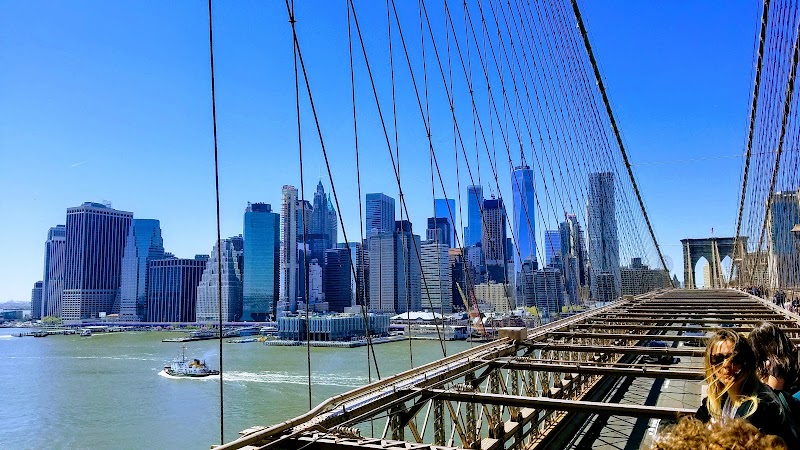
The place is legendary, of course. The area under the bridge is nice. The bridge is usually crowded, I'd advise going before 7 or even earlier. But during the day it's not critical, more like too lively. Nice views in bo…
Very beautiful! Especially when it's dark.
A very nice place! The photos of evening/nighttime Manhattan come out especially well, in my opinion:)