

Park · Brooklyn · ⭐ 9.7/10 · 7051 reviews · updated: 2026-08-04 20:05:49
Address: Montague St &, Pierrepont Pl, Brooklyn, NY 11201, United States
Brooklyn Heights Promenade — the balcony New York built to save a neighborhood
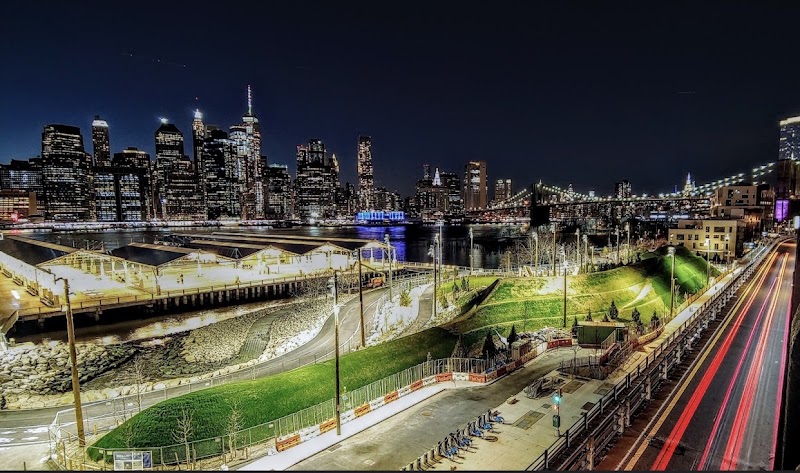
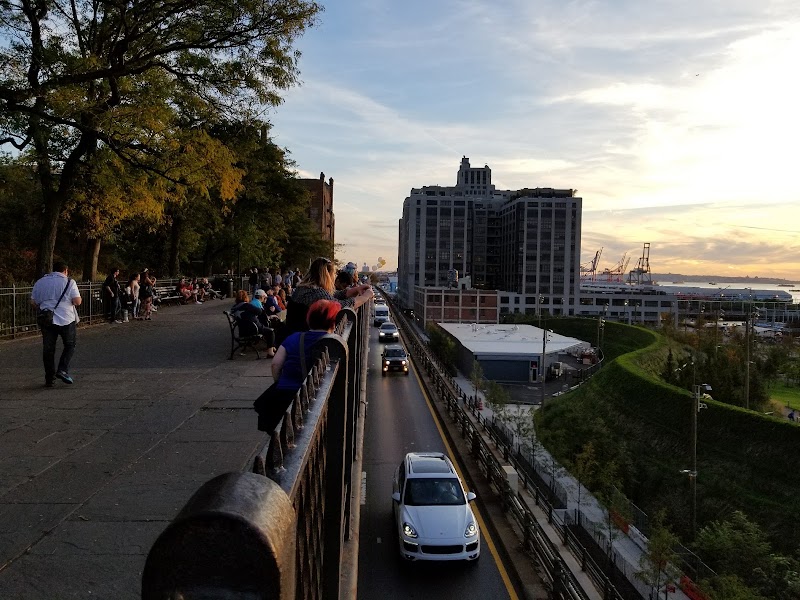
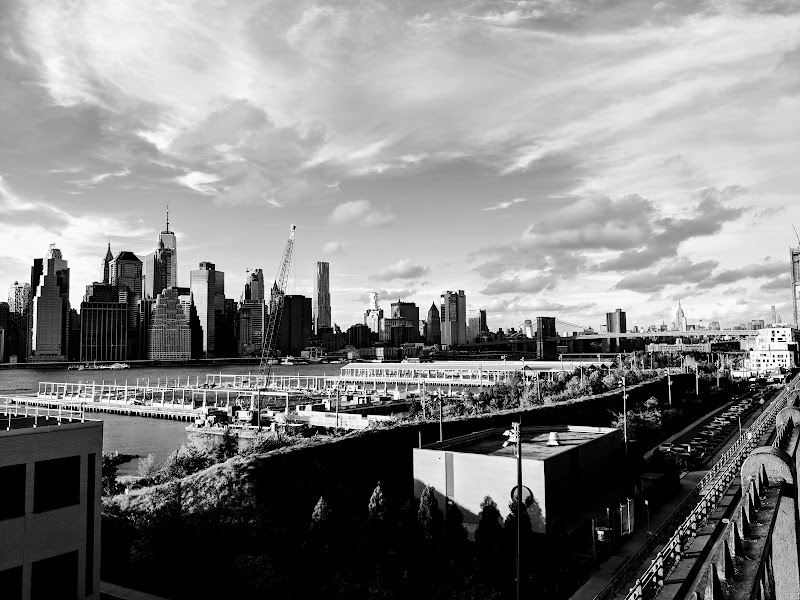
Some parks are gifts; this one is a truce. In the 1940s the city’s most powerful builder wanted an expressway driven straight through the old streets of Brooklyn Heights. What the neighborhood got instead was a slab of concrete hung out over the highway on a stack of cantilevers — planted with trees, lined with wrought-iron benches, and aimed squarely at Lower Manhattan. It runs 1,826 feet along the top of the bluff, about a third of a mile, floating above six lanes of traffic you can hear but never see. Locals just call it the Esplanade. Since 1950 it has been the most generous free view in New York — and the only one the city has written into its zoning code in order to protect it.
Highlights
- The triple cantilever — the Promenade is the top deck of a three-level structure. Two stacked roadways of the Brooklyn-Queens Expressway (BQE, Interstate 278) are carried on cantilever arms driven into the embankment, and the public walkway rides on the slab above them. Engineer Phillips H. Lovering was credited with working out the precise geometry of those arms.
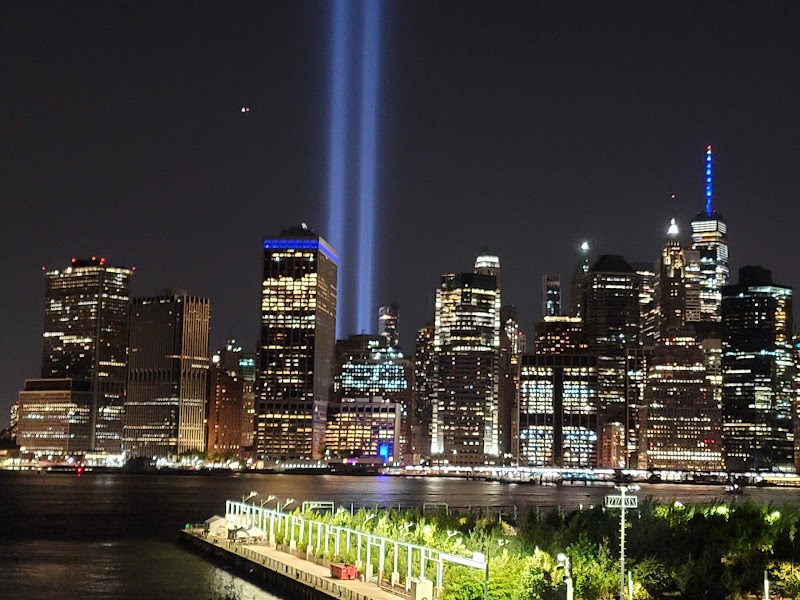
- The Lower Manhattan panorama — the downtown skyline stands directly across the water, with the Brooklyn Bridge (opened 1883) to the north and the Manhattan Bridge (1909) beyond it. It is one of the few places where both bridges and the financial district compose into a single frame.
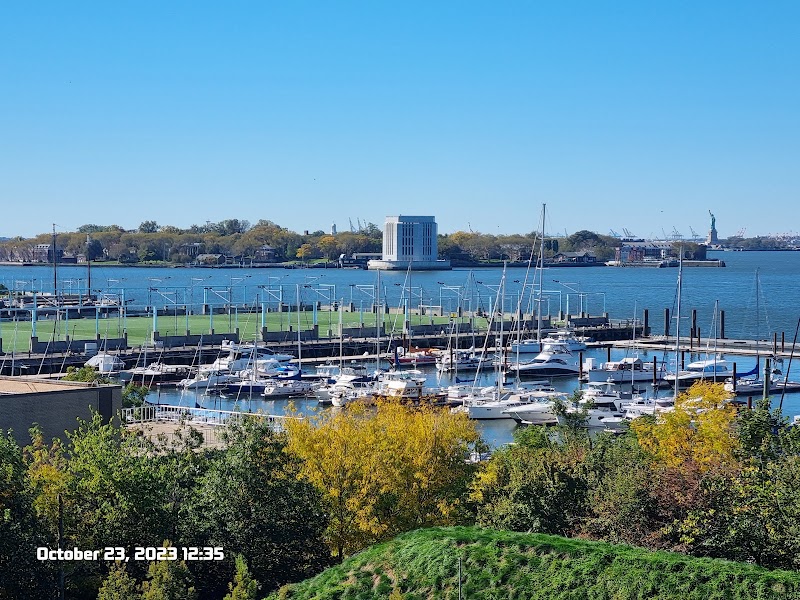
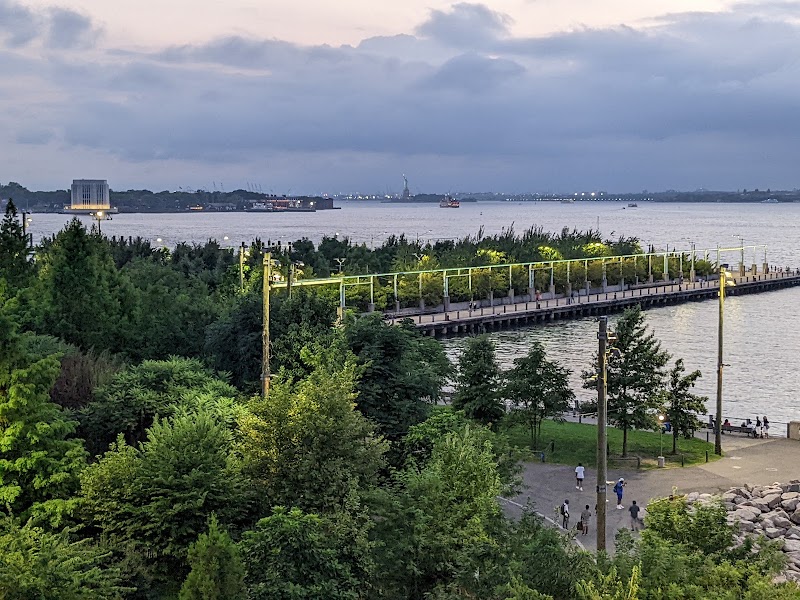
- The Statue of Liberty and the Upper Bay — on a clear day the statue is a small green figure off to the southwest, with Governors Island in the foreground, Staten Island beyond, and the orange Staten Island Ferry boats working back and forth across the harbor.
- A view protected by law — in 1974 the City Planning Commission unanimously created the Special Scenic View District, still the only one in New York City. It projects a view plane out from the esplanade’s western face that new construction may not penetrate without a special permit.
- Benches, trees and plantings — the 1946 scheme by the landscape firm Clarke & Rapuano set a double row of wrought-iron benches along the length of the rail, backed by plantings and a screen of trees on the neighborhood side.
- The Squibb Park Bridge — at the northern end a footbridge steps down from the bluff to Pier 1 in Brooklyn Bridge Park. Rebuilt in steel and aluminum by the engineers Arup on the original supports, it reopened on 4 May 2020 after the bouncy timber original was demolished.
What you’ll find
The Promenade is deliberately plain: one long walkway, a railing, two rows of benches, and everything else surrendered to the water. The small parks strung along its back edge do the rest of the work.
- The esplanade deck — a broad, level, fully paved path running the whole length of the bluff, with no steps along it, easy for wheelchairs and strollers.
- Two rows of seating — one facing the harbor, one under the trees on the neighborhood side, so there is almost always a bench in sun or in shade.
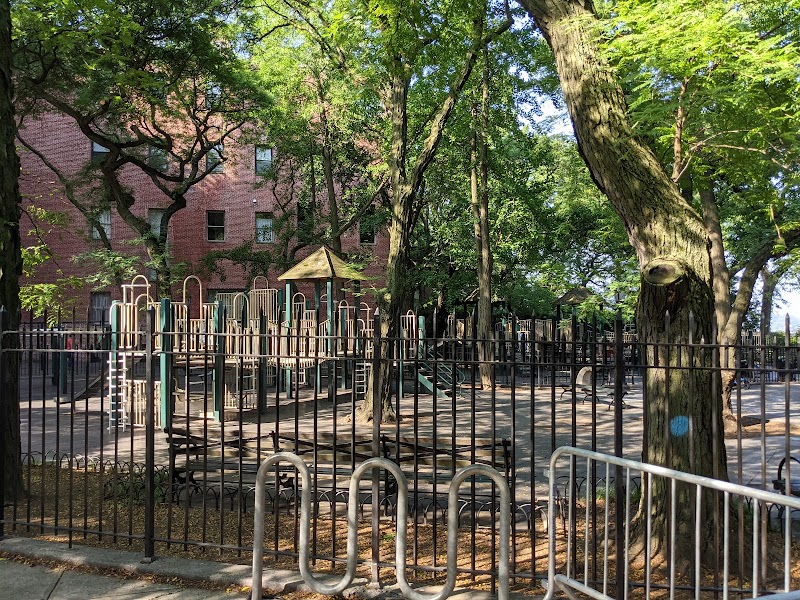
- Pierrepont Playground — a half-acre playground attached to the middle of the walkway, with separate toddler and older-child equipment, public restrooms, and the same skyline view.
- Fort Stirling Park and the pocket parks — a chain of small green squares at the northern end, laid out in the Robert Moses era along the back of the esplanade, including Harry Chapin Park.
- Adam Yauch Park — just past the southern end, a playground renamed in May 2013 for the Beastie Boys’ Adam “MCA” Yauch, who grew up playing on it.
- Squibb Park and its bridge — the northern gateway down to the waterfront, with a play area up top and the footbridge that carries you over the expressway lanes and into Brooklyn Bridge Park.
Things to do — and who it’s for
- First-time visitors to New York — this is the one spot where the Brooklyn Bridge, the Manhattan Bridge, the downtown towers and the Statue of Liberty assemble into a single view, with no ticket, no queue and no lift to the top of anything.
- Photographers — the skyline sits due west across the water, so the sun goes down behind it: the towers turn to silhouette, then the windows come on, and the whole thing repeats in the water. Blue hour here is the reason tripods appear an hour early.
- Families with small children — Pierrepont Playground puts a fenced play area and public restrooms directly on the walkway, so the grown-ups keep the view and the children keep the swings.
- Runners and walkers — a flat, traffic-free third of a mile that connects at its northern end to the Squibb Park Bridge and from there into miles of continuous waterfront path through Brooklyn Bridge Park.
- Readers of history and architecture — behind the benches stands New York City’s first designated historic district: Greek Revival and Italianate rowhouses, brownstone terraces, and Plymouth Church a few minutes inland, where the abolitionist Henry Ward Beecher preached from 1847. Truman Capote lived in the neighbourhood from 1955 to 1965 and wrote its most famous portrait, published in Holiday magazine in February 1959 and later reprinted as “A House on the Heights”.
- Anyone who simply wants to sit — no admission, no gate, no obligation to move on. The Esplanade is one of the few celebrated places in the city where doing nothing is the intended activity.
Getting there & practical
The Promenade runs along the western edge of Brooklyn Heights, the first neighborhood across the East River from Lower Manhattan. The nearest subway is Clark St (2, 3), roughly a four-minute walk; High St–Brooklyn Bridge (A, C) is about as close if you approach from the north. Borough Hall (2, 3, 4, 5), Court St (R) and Jay St–MetroTech (A, C, F, R) all leave you a short walk to the east, and several bus routes stop within the neighborhood. By water, take the NYC Ferry East River route to the DUMBO / Brooklyn Bridge Park landing and climb up through the park and over the Squibb Park Bridge. There is no admission and no ticket — the Promenade is a NYC Parks-maintained public walkway (the structure itself belongs to the city’s Department of Transportation) and entry has always been free. It is unfenced and has no gates; NYC Parks lists it under standard park hours running to 1 a.m., though in practice people are out on it at every hour of the night. Walking the full length takes about fifteen minutes. Allow forty-five minutes to an hour if you intend to sit, and two to three hours if you carry on down to the waterfront.
When to visit
Spring is the gentlest season here: the plantings along the back edge come in, the air is clear before the summer haze, and the benches are busy but not besieged. Summer brings the crowds and the heat, but the bluff has a real advantage — a breeze comes off the harbor almost every evening, and the long daylight pushes sunset past eight o’clock, which makes a weekday evening the best summer slot. Autumn is arguably the peak: the air sharpens, the skyline gains an almost cut-out crispness, the pocket parks turn colour, and sunset slides back to a civilised hour so you can catch it after work. Winter is the connoisseur’s season. The trees are bare, which opens the view at its very widest, the harbour traffic is visible through gaps that leaves hide in July, and the low sun throws the towers into hard relief — but the wind off the water is genuinely cold, so dress well past what the thermometer suggests. Note that snow and ice close the Squibb Park Bridge until it can be cleared, so a winter descent to Brooklyn Bridge Park may need the long way round.
Good to know
In 1941 Robert Moses advanced a route for the Brooklyn-Queens Expressway that would have cut inland through Brooklyn Heights, taking blocks of nineteenth-century houses with it. The Brooklyn Daily Eagle put the objection on its front page on 19 September 1942 under a headline calling the plan shocking, and the Brooklyn Heights Association organised the neighbourhood against it. The solution that emerged was unusual, and its authorship is genuinely disputed. Fred Nitardy, an executive of the pharmaceutical firm E. R. Squibb & Sons who lived on the bluff, is generally credited with proposing that the highway be sunk into the embankment on stacked levels and the private gardens above it rebuilt on the roof; Moses accepted the engineering and changed the terms, insisting the gardens be a public promenade rather than an amenity for a handful of homeowners. Chief engineer Ernest J. Clark later maintained that the design was a team effort that evolved through successive attempts to hold the roadway up, while Phillips H. Lovering was credited with the mathematics of the cantilever shapes. There is an older echo as well: Hezekiah Beers Pierrepont had imagined a private esplanade along the same bluff a century earlier and let the idea go. The waterfront route was adopted in March 1943 and the City Planning Commission approved the concept that May; demolition began in the autumn of 1946, the southern half of the Promenade opened on 7 October 1950, the northern half on 7 December 1951, and traffic ran on the expressway below from 1954. In November 1965 the Landmarks Preservation Commission designated Brooklyn Heights as New York City’s first historic district, only months after the landmarks law was signed. The fight returned in the autumn of 2018, when the Department of Transportation proposed demolishing the Promenade and running a temporary six-lane highway across the bluff for about six years while the deteriorating cantilever was rebuilt. The backlash was immediate and citywide; the proposal was shelved in 2019, and the Brooklyn Heights Association joined eleven other neighbourhood groups in a unified statement to a mayoral expert panel. In August 2021 the city instead cut the cantilever section from three lanes to two in each direction to reduce the load, and cracked down on overweight trucks. A revised plan unveiled in June 2024 would rebuild the structure with the lanes stacked, but requires years of federal review, with construction not expected to begin until 2029. The practical upshot for visitors in 2026: the Promenade is open, intact and not scheduled for demolition, though repair work and monitoring on the structure below continue.
Visitor tips
- Arrive for the last hour of daylight and stay half an hour past sunset. Because the skyline faces you from the west, the good light is the light going down behind it — and the best moment is after the sun has gone, when the towers switch on against a sky that is still blue.
- Walk it north to south, then take the bridge down. Do the esplanade first for the panorama, then double back to the northern end and cross the Squibb Park Bridge into Brooklyn Bridge Park for the view from sea level. The bridge runs 8 a.m. to 10 p.m., so plan the descent before it closes.
- Leave the bike behind, or expect to push it. The Promenade is a pedestrian esplanade and cycling on it is not permitted; on the Squibb Park Bridge, bikes, scooters and skateboards must all be walked across.
Questions & answers
Is there any charge to visit? None. The Promenade is a free public walkway with no ticket, no gate and no reservation. Neither the esplanade nor the adjoining playgrounds and pocket parks charge admission.
What are the hours — is it really open all night? There are no gates and nothing to lock, and you will find people on the benches at almost any hour. Formally, NYC Parks lists it under the standard park hours that run to 1 a.m., which is worth knowing if you plan a very late visit; the public restrooms at the playground keep shorter hours than the walkway itself.
Can I cycle along it? No. It is designated as a pedestrian esplanade and riding is not permitted along its length. Walk your bike, or use the waterfront greenway in Brooklyn Bridge Park below, which is built for riding.
Is the Promenade about to be torn down for the BQE work? No. That was the 2018 proposal — a temporary six-lane roadway laid across the bluff for roughly six years — and it was dropped in 2019 after sustained public opposition. The city reduced the expressway to two lanes in each direction in 2021 to buy time, and the current reconstruction plan, revised in 2024, is not expected to break ground before 2029. Expect noise and periodic repair activity below, not closure.
How do I get from here down to Brooklyn Bridge Park? The Squibb Park Bridge at the northern end is the direct route: a steel-and-aluminium footbridge, rebuilt by Arup and reopened on 4 May 2020, that crosses over the expressway lanes into Pier 1. It is open 8 a.m. to 10 p.m., closes during snow and ice until it can be cleared, and everything on wheels has to be walked across.
Can you actually see the Statue of Liberty? Yes, though at a distance — she reads as a small green figure to the southwest across the Upper Bay, best in clear winter air or after rain. Governors Island lies much closer in the same direction, and the orange Staten Island Ferry boats cross the frame every half hour or so.
Is that the East River down there? By name, yes — but not by geography. The East River is not a river at all; it is a tidal strait connecting Upper New York Bay with Long Island Sound, which is why the current visibly reverses direction with the tide and why the water is salt.
How long is it, and how long should I allow? The walkway measures 1,826 feet — about a third of a mile — and takes roughly fifteen minutes to stroll end to end. Most people want an hour, between walking it, sitting on a bench and photographing the skyline. If you continue down the Squibb Park Bridge into Brooklyn Bridge Park, budget two to three hours for the pair.
Photos
Show 1 more photos
Visitor reviews
Reviews last updated: 2026-08-04 20:05:49
Data is refreshed monthly. Sources: brooklyn-name.com and editorial picks based on reviews.
A redeveloped riverside area with a stunning view of Manhattan, perfect for sunset! A great park for walking and admiring the skyscrapers! You can bring your own food or grab a bite at one of the nearby restaurants and b…
I went to Dumbo and stumbled on this place by chance while checking out the neighboring areas in my free time. I was blown away by the incredible view. You really have to come here.
An impressive walkway above a busy highway. It can be a bit noisy, but it's a pleasant walk with city views. Nice, quiet areas around it. Great for visitors walking around Brooklyn. Lots of benches in long rows facing th…
The Brooklyn Heights Promenade is without a doubt one of the most beautiful spots in New York. Even in winter, when the paths and benches are covered in snow, it feels calm and cinematic. The views of the Manhattan skyli…