

Park · Brooklyn · ⭐ 9.7/10 · 6614 reviews · updated: 2026-08-04 20:05:51
Address: 15 River St, Brooklyn, NY 11249, United States
Domino Park — a sugar empire turned into a quarter mile of open waterfront
For more than a century and a half this stretch of the Brooklyn shoreline belonged to sugar and to nobody else. Behind a wall of warehouses, sheds and cranes, the Domino Sugar Refinery boiled, filtered and crystallized on a scale that once sweetened most of a country, and the neighborhood that grew up in its shadow could smell the place every day but never reach the water. Domino Park is the moment that wall came down. Opened in June 2018 and designed by James Corner Field Operations — the firm behind the High Line — it runs a quarter mile along the East River in Williamsburg, roughly six acres of lawn, promenade, play and salvaged machinery. It does something rare for a new park: instead of scraping the industry away, it keeps the evidence standing upright in the open air, cleaned, painted a signature teal, labeled, and free to walk through.
Highlights
- The Artifact Walk — more than thirty large-scale relics of the refinery, from screw conveyors and bucket conveyors that once moved crystallized sugar between stages, to mooring bollards that held ships full of raw cane, to original dials, meters and signage. Nothing here is a replica: the machines were salvaged, cleaned and reinstalled rather than replaced.
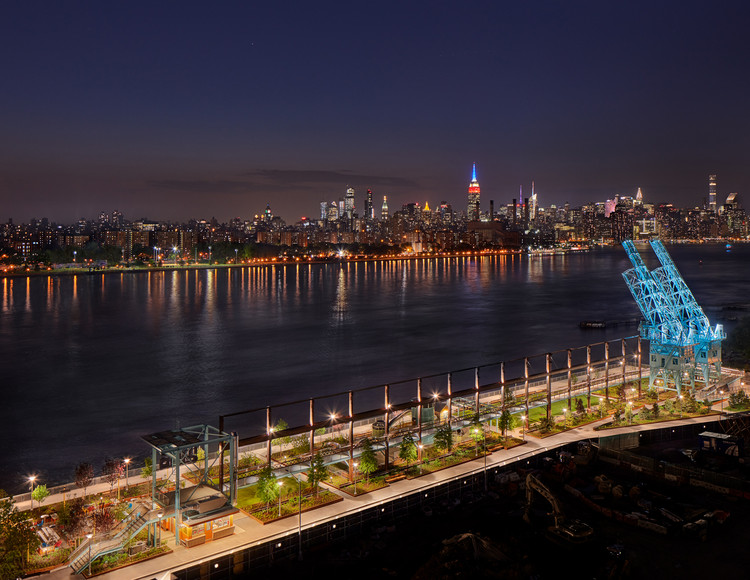
- Two gantry cranes — eighty feet tall, they once lifted bulk sugarcane out of freight ships and into the Raw Sugar Warehouse. Left in place, they now read as the park’s gateposts and carry the elevated walkway.
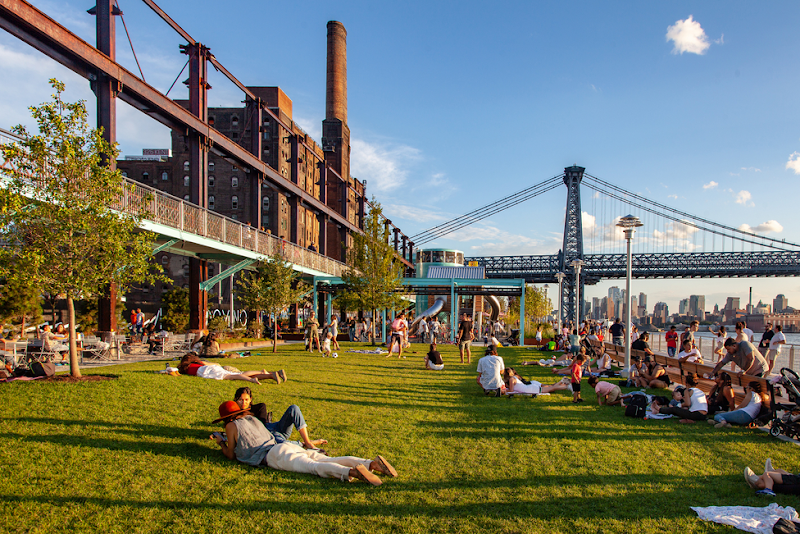
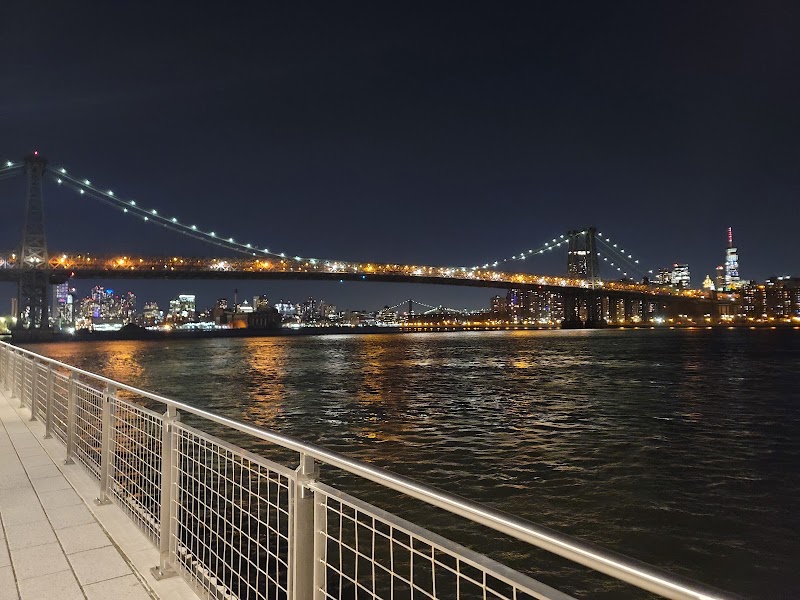
- The elevated walkway — a catwalk spanning several blocks, held up by twenty-one steel columns rescued from the demolished Raw Sugar Warehouse and set back in their original positions. It echoes the bridges that once linked the refinery buildings, and it delivers the best sightlines in the park: the Manhattan skyline across the river and the Williamsburg Bridge stretching over it.
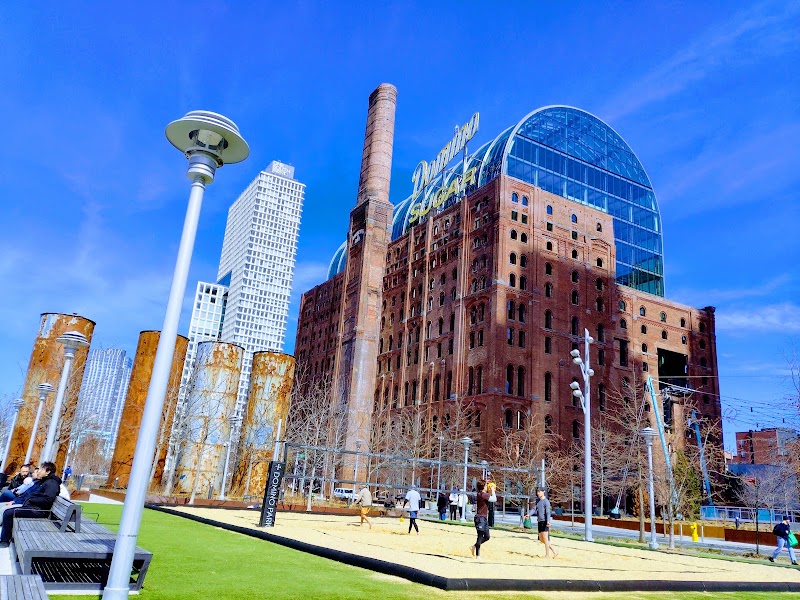
- The syrup tank garden — four cylindrical tanks, thirty-six feet tall and dating to the 1950s, survivors of the fourteen that once collected the liquid sweetener thrown off by sugar processing. They stand on a raised platform at the water’s edge, now with planting around their feet.
- Sweetwater Playground — the artist Mark Reigelman built the play area as a miniature refinery in three stages, from a Sugarcane Cabin to the Sweetwater Silo to the Sugar Cube Centrifuge, so that children move through the process the way cane once did. It uses reclaimed wood from the plant and cast valve wheels off the original machinery, plus stainless-steel slides, nets and tubes.
- The water feature and the fog bridge — a grid of pop jets sends streams roughly eight feet into the air on hot days and drains away to a flat plaza when it is switched off, while a nearby bridge releases a drifting curtain of mist along the walkway.
What you’ll find
The park is laid out as a chain of outdoor rooms strung along a twelve-hundred-foot esplanade, each one with its own use and its own mood, so the quarter-mile walk keeps changing character rather than running on as one long path.
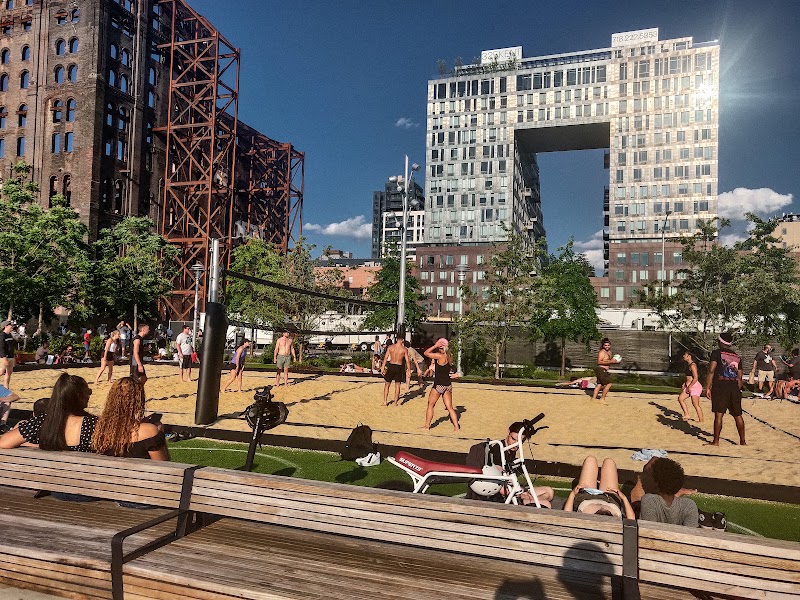
- A full-size beach volleyball court, a nod to the neighborhood’s Latino ballplayers, plus a pair of bocce courts nearby.
- A generous main field and a flex field for pickup games, picnics, concerts and community events.
- A long, narrow dog run, and a lounge area with chaises facing the river.
- Tacocina, an open-air taco kiosk from Danny Meyer’s Union Square Hospitality Group, which has been part of the park since opening day.
- Gardens with roughly 175 trees and native, stormwater-absorbing planting covering a large share of the ground, including some 585 linear feet of original crane track replanted as long beds.
- A Sunday greenmarket from June through November, and in winter a seasonal ice rink, the first in Williamsburg, which needs its own ticket while the park around it stays free.
Things to do — and who it’s for
- Families with young children — the playground is genuinely inventive rather than generic, the water jets are a free summer cooling station, and the whole park is flat and easy with a stroller.
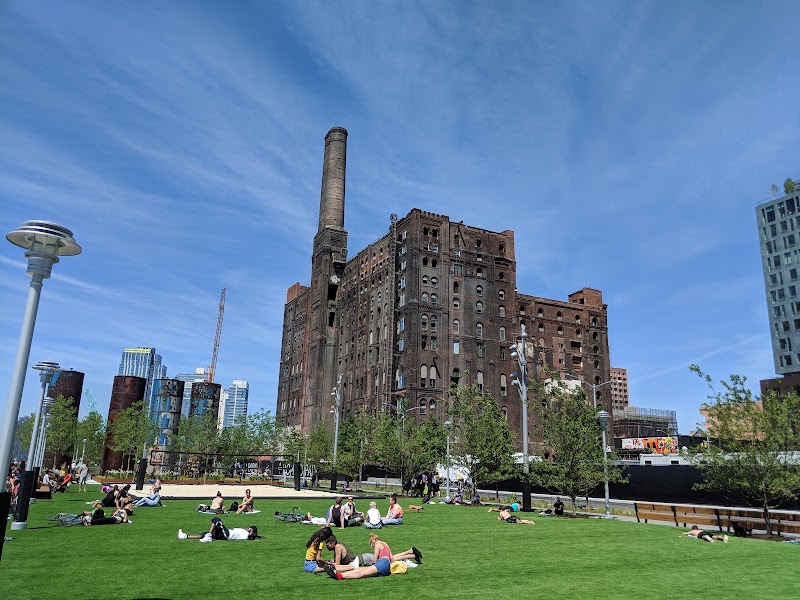
- History and architecture people — this is an open-air lesson in adaptive reuse, with the landmarked 1884 refinery building looming over one end and the salvaged machinery explained on the spot.
- Photographers and skyline hunters — the elevated walkway frames Manhattan through industrial steel, and the west-facing shoreline puts the sunset directly over the river.
- Runners, walkers and commuters — the esplanade links into the broader Brooklyn waterfront route, and the ferry landings make it an unusually pleasant way to break up a trip.
- Dog owners — the run is one of the few waterfront ones in North Brooklyn, and the park hosts dog-centered community events.
- Groups and teams — volleyball, bocce and the open fields make it a default meeting point for after-work games and weekend gatherings.
Getting there & practical
The park sits on the Williamsburg waterfront in Brooklyn, between the Williamsburg Bridge and the northern end of the old refinery site. By subway, take the J, M or Z to Marcy Av, or the L to Bedford Av — either is a walk of roughly ten minutes down toward the water. NYC Ferry’s East River route stops at the South Williamsburg and North Williamsburg landings, and arriving by boat is the best possible introduction to the place. Several local bus routes, including the B32, Q59 and B62, come within a couple of minutes’ walk, and there are Citi Bike docks on all sides. Entry is free and the park is open daily from 6am to 11pm. Allow forty-five minutes to an hour for a proper walk with a stop on the elevated walkway; with children, food and a stretch on the lawn, it easily fills half a day.
When to visit
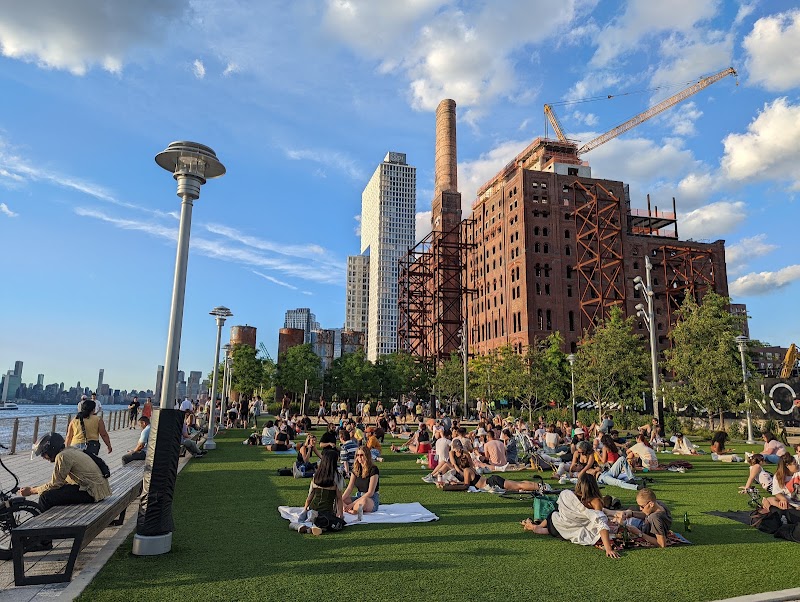
Summer is the park at full volume: the water jets running, volleyball going, the lawn packed, and the sunset dropping behind the Manhattan skyline directly across the river — arrive well before golden hour on a weekend if you want space to sit. Fall is arguably better, with clear low light on the teal steel, comfortable temperatures, and the Sunday greenmarket carrying on into November. Winter strips the park back to its bones, which is when the artifacts read most clearly against a gray river; the wind off the East River is serious, so dress for it, and the seasonal rink gives you a reason to stay out. Spring brings the planting back to life and the quietest mornings of the year — before the crowds arrive, you can have the elevated walkway almost to yourself.
Good to know
The Havemeyer family opened their first Williamsburg refinery here in 1856, and within a decade it was the largest sugar refinery in the world, employing over four thousand workers and processing around three million pounds a day — more than half of all the sugar consumed in the United States. By 1881 the plant was refining roughly three-quarters of the nation’s refined sugar; the Sugar Trust formed in 1887 and was reorganized as the American Sugar Refining Company in 1891. A fire on 8 January 1882 destroyed the complex, and the rebuilt Filter, Pan and Finishing House — a Romanesque Revival mass of brick and round-arched windows — went up in its place and still stands. The Domino brand name was adopted in 1901, taken from sugar cubes that looked like dominoes. Employment peaked at more than 4,500 workers around 1919. In June 1999 close to three hundred members of ILA Local 1814 walked out; the strike lasted twenty months and became one of the longest in modern New York history before ending in defeat in early 2001. The refinery closed for good in 2004, and in 2007 the Landmarks Preservation Commission designated the 1884 building. In 2014 the artist Kara Walker filled a doomed refinery shed with “A Subtlety, or the Marvelous Sugar Baby” — a sphinx roughly seventy-five feet long and thirty-five feet tall, built over polystyrene and skinned in tons of donated white sugar, attended by fifteen smaller figures — a commission from Creative Time that tied the site’s sugar to slavery and unpaid labor and drew enormous crowds over its eight-week run. Two Trees Management bought the eleven-acre site in 2012, commissioned a master plan from SHoP Architects, and built and still privately funds and maintains the park. The landmarked refinery reopened in 2023 as The Refinery at Domino, an office conversion by Vishaan Chakrabarti’s PAU that inserted an entirely new glass building inside the old brick shell, topped by a barrel vault echoing the original round-arch style.
Visitor tips
- Walk the elevated walkway first and the ground-level esplanade second — seeing the salvaged columns and cranes from above makes sense of the layout before you meet the machines up close.
- The shoreline faces west, so plan around the light: sunset over Manhattan is the reason half the park shows up in the evening, and the same view is far emptier at breakfast time.
- This is a privately maintained public space, not a city park, and the house rules are enforced: dogs leashed outside the run, no grilling or open flames, no amplified sound, no alcohol except at Tacocina, and no climbing on the artifacts.
Questions & answers
Is Domino Park free? Yes. Entry is free and always has been, and the park is open every day from 6am to 11pm. The only paid element is the seasonal winter ice rink, which sells its own tickets.
Is it a New York City park? No — it is a privately owned public space. Two Trees Management built it, funds it and maintains it, rather than NYC Parks, but it is open to everyone at no charge.
Are the industrial pieces real, or decoration? Real. Over thirty large-scale artifacts were salvaged from the refinery, cleaned and reinstalled — the twenty-one warehouse columns even stand in their original positions, and the gantry cranes and syrup tanks did the jobs the signs describe.
How much time should I allow? Forty-five minutes to an hour covers the walk end to end with a pause on the elevated walkway. Families with children, or anyone eating and settling on the lawn, should budget half a day.
Can I bring a dog? Yes, on a leash, and there is a dedicated dog run along the park. Dogs must stay leashed everywhere else, and the park runs dog-focused community events through the year.
Is this where Kara Walker’s sugar sphinx stood? It is the same site. “A Subtlety” was installed in a refinery shed here in the summer of 2014, shortly before demolition cleared the way for the redevelopment; the park now occupies part of that footprint.
What happened to the big brick refinery building? It was landmarked in 2007 and reopened in 2023 as The Refinery at Domino — a new glass structure built inside the preserved brick shell by PAU, with a barrel-vaulted top. The ground level opens toward the park.
Will it flood? It is engineered against that. After Hurricane Sandy the platform was raised several feet above FEMA flood elevations, and the planting is designed to absorb stormwater and act as a first line of defense against surge and sea level rise.
Photos
Show 1 more photos
Visitor reviews
Reviews last updated: 2026-08-04 20:05:51
Data is refreshed monthly. Sources: brooklyn-name.com and editorial picks based on reviews.
One of the best park views in Brooklyn, you have to visit this place at least once, there are always so many people here and it's a great place for skating, the bike paths run all the way to River Street. Great food in t…
Quite possibly my top 2 favorite experiences in nyc. I visited during sunset, and the views of the Manhattan skyline were absolutely breathtaking. What made the experience even more special was the sense of community. Th…
Great views of the water and the bridges! The clean parks for dogs, kids and animals were a plus. It was very peaceful.
Domino Park is a phenomenal spot to relax on the Williamsburg waterfront, perfectly blending Brooklyn's industrial past with its vibrant present.
Set beneath the gaze of the historic, beautifully restored Domino Sugar R…
A beautiful urban green space that reflects the history of New York. Kids can play, you can sunbathe, play volleyball, have a few margaritas and tacos, enjoy the view and surround yourself with the city's diversity. I lo…