

Park areas are an important part of any city. Basically, they are the main vacation spots in nature for city dwellers. But green plantings are incredibly important for ecology, especially in big cities, where exhaust gasses threaten people’s health.
Everyone knows about the main park of New York, the Central Park. But Brooklyn has its own beautiful park areas that play an important role in the lives of Brooklyn citizens. Find out more at our website brooklyn-name.com.
Domino Park
One of Brooklyn’s public parks was named after the Domino Sugar Refinery, on the territory of which it is located. They decided to honor the memory of the refinery in a rather unusual way. The park itself stretches along the East River and the Williamsburg Bridge for five quarters. A variety of vintage factory equipment is displayed along the promenade.
Two Trees Management company spent 50 million dollars to create this park. It was opened in 2018.
In addition to the exhibition of the sugar factory equipment, the park has a variety of other interesting places for Brooklyn citizens to relax. For instance, these are a volleyball court, a children’s playground, a dog walking area and a bocce court.
The founders of the park installed a volleyball court for a reason. A significant part of residents in Williamsburg are of Hispanic origin and their favorite sport is volleyball. In such a way they paid tribute to the nation.
In addition to the plant equipment and sports fields, a large number of different plants grow in the park. In the southern part there is a small fountain. Different types of trees have a positive impact on the air quality in Williamsburg.
Not only Brooklyn citizens, but also New Yorkers love this park. By 2020, two million people had visited the park. It even received a nomination for the “Urban Space 2020” award. During the global COVID-19 pandemic, the park did not close its gates to visitors. City services put signs on lawns that meant social distancing.
Marine Park
Marine Park is surrounded by Shore Parkway in the south, Gerritsen Avenue in the west, 38th Street and Flatbush Avenue in the east and Fillmore Avenue and Avenue U in the north.
The history of the park’s territory is long and rich. Before the arrival of the Europeans, Indians lived on the modern territory of Marine Park. This is evidenced by the discovered ancient objects. Their age dates back to 800-1400 years. They were mostly engaged in fishing. The Dutch colonists also preserved this activity. They liked the area, because it was suitable for farming, there was a source of fresh water, and there were plenty of fish and shellfish.
The idea of establishing a park on this territory arose in the 20th century. Urban developers were developing a plan of Jamaica Bay construction to create a port. But this land was privately owned by the Whitney family, as well as by Frederick Pratt and Alfred White. They believed that the construction of a port on this territory would harm the salt marshes. The city authorities considered the decision of the owners to give the land for the city park as an act of philanthropy. Although the landowners themselves looked into the future and assumed that this would increase the value of the land. They were right, as the city authorities did not immediately allow the establishment of the park. The construction also moved quite slowly, although the territory around the future park began to be actively built up. In 1937, the park received its first name Marine Park Brooklyn. Over the following decades, the park finally formed its dimensions – 3.2 km².
The main part of it is occupied by a marsh. This is a category of wetlands that is occasionally flooded by a reservoir. In the middle of the 20th century, the entire territory of the marsh was an improvised landfill. Only in the 1990s, it was completely cleaned. It is right, because the marsh is a unique and most important phenomenon for the nature and ecology of the city. Natural reproduction of crabs, shrimps, and fish takes place in the marsh. About 40 species of birds also live there. The importance of the Brooklyn marsh was highly appreciated by scholars. In 2000, the Salt Marsh research center was built there. In addition to the scientifically significant territory, the park has children’s playgrounds, sports fields for playing golf, baseball, tennis and bocce. Apart from sports, hiking trails for slow walks stretch through the park.
Park under the bridge
Brooklyn Bridge Park is located along the shoreline under the famous Brooklyn Bridge. Its area is 34 hectares. Brooklyn citizens love it for its beautiful views of Manhattan, gorgeous gardens and hills and walking paths.
When the Brooklyn citizens walk through the park, it is difficult for them to imagine that this whole place could not exist. Earlier, there were berths and storage facilities on its territory. In the 20th century, Brooklyn had many marinas and ports. But with the development of the borough, the need for the port decreased. The number of shipments declined, and in the 1980s, the ships ceased to enter these places at all. Then they wanted to build a residential area there, but the Brooklyn citizens protested and were able to achieve the creation of the park. The organization Friends of Fulton Ferry Landing (now the Brooklyn Bridge Park Coalition) took over this challenging responsibility. The negotiations lasted for a very long time. Only in 2000, the creation of the park began.
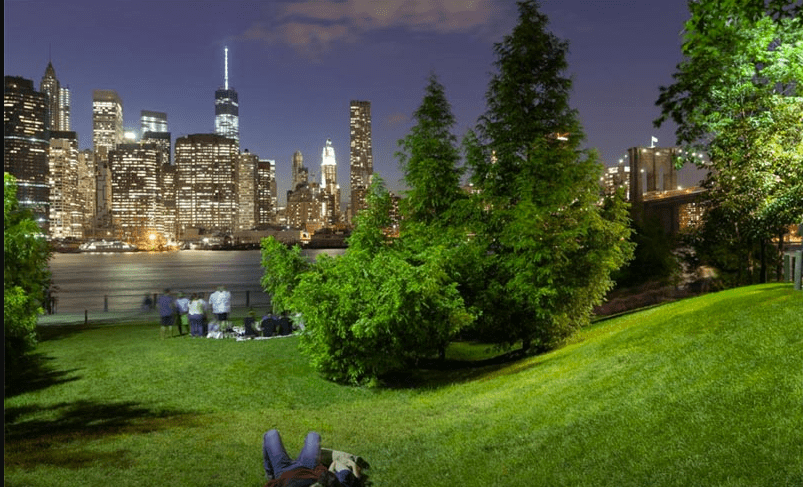
At first, the “founding father of the park” Thony Manheim wanted to make the park as quiet as possible, that is, without sports fields and noisy amusements. In his vision there were alleys with lush vegetation, benches and large green spaces.
The wish of the “founding father” was partially fulfilled. The park has a large number of green spaces, gardens, green meadows and hills. One of them is located at Pier №1 and is called Brooklyn Bridge Park’s Hill. The landscape architect Michael Van Valkenburg stood up for the creation of this hill, as there was heated debate. Many believed it would only hinder the park. It became a successful alternative to a simple flat stone piece of land.
The hill was originally built from stone, which was mined during the construction of the Long Island Railroad tunnel under Manhattan. Over time, the hill overgrew with its own microenvironment.
Cadman Plaza
One of the main national parks of New York is located exactly in Brooklyn, or rather in its northwestern part. It forms an alliance with another park, the Columbian Park. It was named after the American Congregationalist Samuel Parkes Cadman. There used to be other things on the site of this park. For example, the remnants of the old tram depot had been preserved at Cadman Plaza, which was later redesigned into the Korean War Veterans Memorial Square and the Supreme Court.
Cadman Plaza, like other Brooklyn parks, is not just an area with green spaces. There is a significant landmark for New Yorkers, a statue of Mayor William Jay Gaynor. City dwellers know him as a well-known anti-corruption fighter. Apart from that, he was very close to ordinary people. Every day he walked on foot through this park to work across the Brooklyn Bridge to Manhattan.
In addition to that, the park has a memorial to Brooklyn citizens who died during the Second World War. It was opened in 1952. The vegetation of the park is represented by leafy plantations and fragrant flower gardens. It is not only a beautiful place for a romantic walk but also a great example of creating a green area.
Another feature of Cadman Plaza is that it is a national park. Its territory is guarded with special attention. However, it is a great place for a leisurely walk or morning jogging in solitude. Due to the fact that the park is on a special account, noisy companies on picnics cannot be found there.